Why I Write

Photography is on the long list of things I want to be able to do but for which I have no talent, along with drawing, woodworking and pairs figure skating. And the common thread in all of that is my inability to turn those things I imagine into reality. That, and weak ankles.

I understand photography principles. I took those classes in journalism school and I took good notes. I can talk all about ASA and shutter speeds, and the differences between Kodacolor, Kodachrome and Ektachrome.

OK, so it’s been awhile.

But I can also expound upon the rule of threes; about using natural lines and shapes to draw your eye to a focal point; the importance of getting close to your subject, all that stuff.

But here’s the thing: I can look at something and imagine what the picture ought to look like. I just can’t take that picture. Not in the viewfinder and certainly not on the desktop. No amount of Photoshop can save it. I can’t translate what I think into what I see.

I guess that’s why I write. Reality doesn’t have to get in the way. Whatever I can think I can write. No harsh shadows, no blurs. I don’t have to worry about hitting the shutter just a fraction too soon or too late.

Case in point. I was at the 1982 U.S. Open Golf championship at Pebble Beach. I had conned my way into not only press credentials but a photo badge. I was inside the ropes with my Beseler Topcon. Perhaps you remember, this was the Open that Tom Watson won, beating Jack Nicklaus by chipping in for birdie from impossibly heavy rough at the back of the 17th green. Everyone else crouched in front of the green got a picture of the ball in the air headed for the hole. I got Watson pointing back at his caddie Bruce Williams, saying “I told you so.” Not much of a picture. I missed the moment.

Maybe it’s not me. Maybe it’s the camera. But no, a better camera just made my bad pictures more expensive.

On the other hand, I can write the same sentence with a pencil as I can with a Macbook Pro and no one knows the difference. Not that there’s a single thought in these nine paragraphs that anyone would hang on the wall (though the pairs figure skating line was sort of a nice touch).

I’ll admit though, that as a writer I am weak at descriptions and much better at dialogue. I wrote television news for far too long, where descriptions aren’t necessary. You have a photographer for that. I’m told that pictures are worth… a couple of hours of overtime.

In television news, the closest you get to describing anything are the words this and that. As in “the driver of this car drove into that house.” Doesn’t look like much here, but on TV, you’d get it. First rule of television news “say cow, see cow.” Don’t have a picture of a cow, don’t talk about it.

That’s why I want to be able to take pictures. To see cows. Cows that, by their very existence, describe the human condition. Gaunt and standing in a field bare of grass, far from the nearest water, with blank bovine stares silently chewing their cud. Never mind that there is precious little to chew. It is their nature. Standing motionless for hours, only their lower jaw moving.

Oh fuck, never mind, I hate cows. Dumbest animals on earth. Except, you know. Horses.

Broadcast Writing

A friend commented on one of my posts recently that I seemed to have lost my ability to write in complete sentences. Fact is, I never could write in complete sentences. Microsoft Word points out the same thing. My page is filled with squiggly green underlines and the admonition “Fragment (consider revising).” I don’t consider it, and not only because the advice is a fragment in itself. It’s just the way I write.

After all I spent most of my adult life in and on television.

I owe my career in broadcast news to whoever invented the ellipsis. Proper punctuation has no place in television.

It’s a language of phrases… pauses and emphasis and nuance. You can write complete sentences, but they better be short. It’s being read out loud after all and it is best read aloud by the people who write it. It’s hard to write in another person’s voice; to construct a sentence the way they are comfortable reading it. Yet that’s what I tried to do for most of my career. I gave up reading my own writing very early on. It became apparent to me that I could write reading a lot better than I could read writing. (And that says more about my reading than it does my writing). Even at that, I wrote for very few people who could read my writing. For everyone else…I wrote their reading.

For instance. Shortly after I went to work in Greenville South Carolina I wrote this little story:

DAVID JANSSEN .. WHO RAN ACROSS OUR TELEVISION SCREENS FOR FOUR YEARS AS “THE FUGITIVE”.. DIED TODAY.

HEART ATTACK.

48.

The anchor couldn’t read it.

He went on the air with “Actor David Janssen, who played “The Fugitive” for four years, has died of a heart attack. David Janssen was 48 years old.”

He ruined my story. But in those two sentences I learned I couldn’t write for him the way I wanted to. I had to write the way he wanted to read. That’s the job.

I think my story had emphasis and even a little drama. “Heart attack” “48” were meant to stand alone, to make people say, god he died young.

The rewrite had no soul. It was wire copy. I was expecting him to end it with “he’ll be missed.” But if he had, I would have walked out then and there and never come back. As it was, I worked in Greenville a total of 89 days before I got a job in San Diego.

There, I would drop by the station on weekends just so I could write for Mitch Duncan. He could read my writing. Because it’s how he wrote too. He paused when he was supposed to; not when he was out of breath from reading some ridiculously long sentence full of prepositional phrases. The copy was a mess. Filled with enough dots and dashes to be Morse code. But he could read the hell out of it.

Pick up any textbook on broadcast writing and if the first paragraph of the first chapter doesn’t say it should be conversational, burn the book.

Think about it. When you first told someone Robin Williams had died you probably said “hey, did you hear? Comedian and Oscar-winning actor Robin Williams has died at the age of 63, according to a spokesperson for the actor. The Marin County Medical Examiner’s office reports it is suspected to be a suicide.”

Didn’t you?

If you did, you could anchor the news in Greenville South Carolina.

I learned most of what I know about broadcast writing by listening to other people write. You can’t figure out broadcast writing by reading it. (Or reading about it for that matter, so if that’s why you’re here you can stop now). It’s meant to be heard. I listened to one person in particular.

David Brinkley.

If you didn’t see David Brinkley, or if you only know him as the gray haired old man slumped in a chair on a Sunday morning talk show, you missed a great opportunity. The news anchor with the staccato style and razor-sharp wit. He single-handedly changed broadcast news. And my god could he write.

Brinkley anchored the NBC Nightly News, first with Chet Huntley and then with John Chancellor, and unlike a lot of news anchors, he wrote every word he read. He wrote without flourish but not without flair. With purpose, but without verbs.

Take for instance the night in 1977 when he did a little story about James Earl Ray’s arraignment for escaping from prison. As best I remember (it was 1977 after all) Brinkley wrote it this way:

JAMES EARL RAY… WHO KILLED MARTIN LUTHER KING, JR… ESCAPED FROM THE BRUSHY MOUNTAIN STATE PRISON IN TENNESSEE. FOUND THREE DAYS LATER… MUDDIED, BLOODIED AND LYING UNDER A PILE OF LEAVES.

WENT TO COURT AND SAID HE DIDN’T DO IT.

EVEN THOUGH HE DID.

It has stayed with me all this time because he had the gravitas to tell the truth. Too many broadcasts would have reported “James Earl Ray, the assassin of Martin Luther King has been charged with escape and today pleaded not guilty to the charge. Ray is accused of escaping from prison in Tennessee and was captured three days later after an extensive manhunt.”

It is boring, sterile, confusing and ridiculous.

That last line….”even though he did”…took some guts. But I’m sure Brinkley didn’t see it that way. It was just the right thing to do.

Or consider this one —

P.K. WRIGLEY … THE CHEWING GUM MAGNATE… WHO STOOD BY THE CHICAGO CUBS THROUGH THIN AND THIN… DIED TODAY.

Also Brinkley. (Also 1977).

Irreverent? Maybe. Memorable? Definitely.

I wrote and produced television news for more than thirty years and can honestly only remember bits and pieces of three or four stories I wrote. After all, as soon as it’s off your fingertips, you’re on to something else. You don’t languish over it… you knock it out and move on. There’s a pile of other work that still need to be done and the clock is ticking. Plus, as we were fond of saying, as soon as the anchor has read it on the air it’s “on its way to Mars.” (I did most of my work before You Tube. Can you tell?)

My first story as a reporter in Waterloo Iowa was about a developer who wanted to turn an abandoned stone quarry into a residential tract. There were a lot of people still in the newsroom when it aired and I felt as though they were watching to see what the new guy’s story was like.

Or maybe I’m just self-conscious.

OK, I’m definitely self-conscious. Leave me alone, all right?

Stop staring.

I mean it, stop.

Anyway, the opening line was – A LOT OF PEOPLE LOOK OUT AT THE OLD (insert forgotten name here) STONE QUARRY AND SEE …. A STONE QUARRY. (insert forgotten name here) OWNS THE PLACE. HE SEES CONDOS.. SHOPS AND PARKS.

(For the uninitiated, I’m not shouting. Broadcast copy is written in all caps. Except by Brinkley who wrote in upper and lower case. Or so I’m told.)

Some time later, still in Waterloo, I was producing the news and wrote a sentence I like.

First, some background. There are several bridges across the Cedar River in Waterloo and one of them needed some repair. The Army Corps of Engineers was doing the work, and said the bridge would be closed for six weeks. It took longer…of course…and…of course…was a major inconvenience. When they let us know they were going to cut a ribbon and let the Mayor drive across the bridge one evening and then open it the next morning to traffic, it was welcome news.

So we shot the ribbon cutting and I wrote the story, that ended with … AND THE ARMY CORPS OF ENGINEERS PROMISES .. THE FOURTH STREET BRIDGE.. CLOSED FOR SIX WEEKS…. FOUR MONTHS AGO.. WILL BE OPEN IN THE MORNING.

It was all true. And it made several points, all at once. There’s a little bit of Brinkley in there.

Then there’s the David Janssen story. That didn’t go so well.

In San Diego in 2001 there was a shooting at a school. Our coverage won the National Headliner Award for Spot News coverage and an hour special that we turned around in short order won the Headliner for Public Service Program. It was pompously called “Preventing the Pain: Real Solutions for Stopping Youth Violence.” It could have won honorable mention for worst broadcast title, but that wasn’t a category. Colons have no place in broadcast writing. Ever. But then, I don’t write titles.

We didn’t succeed in stopping youth violence, maybe you noticed, but I had a line in the anchor copy somewhere that said

THERE IS SOMETHING ABOUT THE WAY KIDS GROW UP IN THIS COUNTRY.. THAT MAKES THEM WANT TO HIT.. AND HURT.. AND HATE

I know, by itself it’s a pretty much indefensible statement. But it was in amongst a bunch of other phrases about studies and sociology. Those don’t matter now. It’s about the alliteration.

So there it is. A career of daily news writing summed up in four sentences. For the rest, you’ll have to go to Mars.
Thank You

Today, I want to tell you about something that bothers me. I want you to know about it because maybe it bothers you too. And if it doesn’t yet, it will after you read this.

It’s something people do often when they accept an award or honor. When Steve Thomma gave his “farewell” address as president of the White House Correspondents Association he must have done it at least a dozen times. He had a bunch of people to thank and as he mentioned each one of them he said “I want to thank” the board, I want to thank the committee, I want to thank my editors, I want to thank my co-workers, I want to thank the waiters, I want to thank the caterer, I want to thank my family.” Maybe he did that so that Joel McHale wouldn’t be the worst speaker of the evening, but I suspect it was just that he didn’t know any better.

Toni Atkins was sworn in as Speaker of the California Assembly today and she did it too. “I want to thank my spouse, I want to thank the outgoing speaker, I want to thank the governor, I want to thank .. I want to thank.. I want to thank….”

Halfway through the speech I’m screaming at the television. You’re standing at the podium, the microphone is on, everyone in the room is looking at you, just go ahead and thank these people if that’s what you want to do.

I want to know why people do this. If there were degrees I could understand it: I want to thank these people, I need to thank those people, I’m expected to thank that guy, I have to thank her or she’ll write me out of her will, I’m going to thank him because it will mystify everyone. But they don’t do that. It’s always “I want to thank…” The speech would take up half the time if they would just say thank you. Or for that matter, call them later and thank them, and spend the time at the podium saying something meaningful.

That’s what ought to be done and it would make a big impression. So remember that if you ever have to give a speech at an award show. Say something meaningful. People will go away thinking you’re very bright. It’s good advice.

You can thank me later.

-0-

I read something funny today. Funny odd, not funny hilarious. The football coach at the University of Minnesota is doing a road trip around the state, ostensibly to thank the people who support the team, but more than likely to try to drum up ticket sales.

Anyway, in making the announcement, the intern in the sports information office who wrote the release said the coach would be traveling across “Greater Minnesota”. I remember, when I lived there forty-some years ago, that Minnesotans would talk about the Greater Metropolitan area, which meant not just Minneapolis and St. Paul, but the entire Seven County Mosquito Control District.

But Greater Minnesota?

I thought maybe that meant the coach would be going to places not only in Minnesota but also a few in Wisconsin, Iowa and North and South Dakota because how else could it be Greater Minnesota. (Never mind that Minnesotans believe Wisconsin, Iowa and the Dakotas constitute Lesser Minnesota; places that just wish they were Minnesota). But no, all the stops are in Minnesota; places like Park Rapids, Owatonna, St. Cloud, New Ulm, Red Wing and Coleraine. The garden spots.

Someone needs to have a little talk with the intern in the sports information office.


On Writing

Funny thing happened this week. San Diego’s chapter of the Society of Professional Journalists held its awards dinner and along with a great many well-deserved recognitions,  gave the Herbert “Woody” Lockwood Award for Humor Writing to this blog.

I was not there to accept it because the last time I stood in front of a large group of people and got a woody it wasn’t a pleasant experience.  I was probably about 13 but like receiving this richly undeserved award, it was both memorable and embarrassing.

The difference is I’m talking about this one. Having spent something more than 30 years writing what passed as serious news stories, getting recognized for humor writing is a major change of pace.

It is also the only sort of formal recognition I’ve ever received for writing.  There are writing categories in television awards, but I never thought my stuff qualified.   Writing television news doesn’t feel like writing, even to me, because if someone wearing makeup and reading out loud is the only person to read it, it’s not really writing, no matter how many people hear it.

Of course by that standard—and several others—this blog is still just barely writing.  Not that anyone is reading this out loud, I hope, but the loyal following is somewhere between the middle single figures and the low double figures.

Spending a career writing stories that are measured in seconds instead of pages means I don’t really have anything to show for it. Once it’s read on the air it’s in the air and on its way to Mars.

Several years ago, a friend who was also a news producer was at my apartment and pulled a book from my bookcase — How to Make $30,000 a Year Writing. “You do, you know,” she said.  That says a lot about a lot of things, primarily my impression of what I think writing is, and the kind of salaries news producers get.

So thank you SPJ for this misguided recognition of which I’m rather proud.

Pens

I always carry a pen.  Always.  OK, not in the shower.  Well, not on the golf course either, but then I have a pencil. My pen is on the bedside table, though there may not be paper there.  But otherwise, always.

Some people call them ink pens, which I always thought was redundant.  But maybe they feel the need to distinguish their pen from the one that encloses pigs or prisoners.

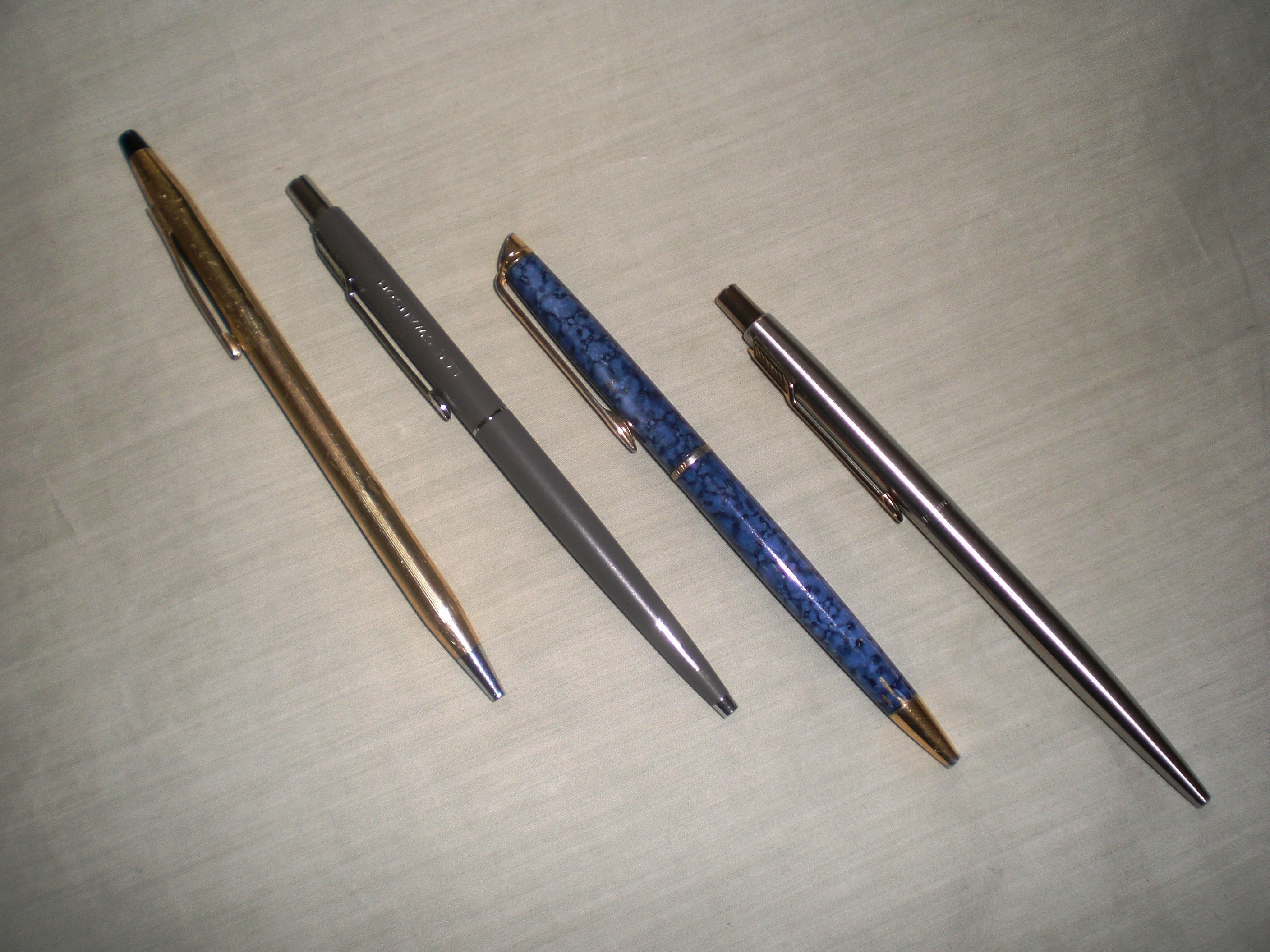
When I was sixteen, my parents gave me a gold Cross pen.  It was the first good pen I ever had and I still have it.  I carried it in my shirt for more than twenty years.  In my shirt, but not in my shirt pocket.  I put my pen in the placket of my shirt, between the second and third buttons.  I never put it in the pocket.  When I used to wear ties, the tie would cover up the pen.  On one of our trips to Thailand, I had dress shirts made for myself, and I had them made without a pocket.

One day when I lived in Portland Oregon I was running across the street in the rain and the pen fell out of my shirt and I stepped on it.  I didn’t know it had fallen, but I felt it when I stepped on it.  Crushed it pretty badly and it wouldn’t turn to retract or extend the point of the pen.

Fortunately, when I was best man at a friend’s wedding he had given me a Parker pen and pencil set with my name engraved on the barrels.  So I replaced the Cross with the pen from the set.  Never really used the pencil.  I carried that pen for several years until one day I dropped it in the car and it wedged into that little crevice between the driver’s seat and the console, next to the railings that move the seat back and forth.  It’s impossible for me to get my fingers down there and still keep them attached to my hand.  I tried lying on the floor in the back seat and reaching under the seat and I could touch the pen but I couldn’t move it.  So I took a coat hanger and went fishing for it.  I got the pen out but managed to scratch up the finish of the pen pretty badly.

Since it was as much a keepsake as it was a pen I put it in the drawer so it wouldn’t get any more scarred than it already was, and I bought a Waterman pen.

I carried this pen until about a year ago when it simply disappeared one day.  It wasn’t on the dresser, the bedside table or in my shirt.  Those are the only places a pen belongs and it wasn’t in any of them.  After I looked where it should have been, I looked where it should not have been; one or two of which I should not have been either.  It was nowhere to be found.

I was a little upset, but I was more angry than anything.  Obviously I don’t lose things.  I particularly do not lose pens.  But I couldn’t find it and I had to have a pen so I bought another Parker.

Then one day Cheryl took the grill off the front of the refrigerator to vacuum the lint out from in under it, and out came my Waterman pen.  A little dusty but none the worse for the experience.   My four pens

So now I have them all; the four pens of my life.  At least the past forty-four years of my life – and counting.

You might think that since I always have a pen that I do a lot of writing.  Aside from taking notes on phone conversations and signing birthday cards and credit card receipts, I probably don’t use a pen for much.  I don’t remember the last time I used my pen to write a letter.  I learned to compose my thoughts at the typewriter when I was in journalism school and have been writing at a keyboard ever since.

And I imagine the pen’s days are numbered.  It will go the way of the typewriter, the slide rule, 45’s, film and VHS tape; replaced by the iSomething.

It is increasingly difficult to find refills for my pen.  Drug store clerks look at you quizzically if you ask for a pen refill.  Even some stationery stores don’t carry them though you would think that if anyone had a vested interest in selling ink it would be the store that sells paper.

Which makes me wonder how much longer the ink supply can last anyway?  I suspect there will come a day when it’s just not economical to drill for ink any more.  When it was just us pen users who needed ink the supply seemed endless.  But then came the typewriter, printing press, adding machine and now every house probably has a printer next to its computer.  That’s an enormous amount of ink coming out of the ground.

When they sink an ink drill into the ground the first ink to come up is red. It is closest to the surface. But since it is only used by teachers and accountants there is not much demand for red ink so the drillers usually press on.  No one is exactly sure why ink changes color deeper into the earth, though it’s obvious that it does.  Soon, the ink turns dark blue.  There is a gigantic pool of blue ink.

Deeper still is the black ink. It is the oldest ink and the most difficult to bring to the surface. And it is used for just about everything.  I use black ink in my pen.  Always have.

I’ve had people try to tell me that you can’t drill for ink, but those people have obviously never heard of an ink well.

Headlines

An Associated Press a headline today said Executives Don’t See Reason to Panic, Yet.  It was the first I realized panic is a reasoned response, arrived at only after long and considered study.

“Elizabeth, arrange a conference call with the board.  I’ve been looking over these balance sheets for two days now and I think it’s time to take a vote on panicking.”

“A videoconference, sir?”

“No, just on the phone.  I don’t want to tip my hand by letting the board see that my hair is on fire.”

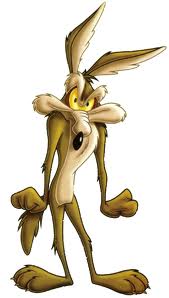
Wile E. Coyote

Acme Industries’ Board Votes 7-6 Against Panic

Director Wile E. Coyote Casts Deciding Vote

“I’ve seen worse,” Coyote explained.  “Once you’ve run off the edge of a cliff with an anvil and a case of dynamite strapped to your leg, a few drops in stock prices don’t scare you much.”