
As we embark upon our first ever trip to Europe we find ourselves deposited in London at the conclusion of our Fast and Furious tour of Amsterdam, Cologne, Lucerne, Paris and all parts in between. I’m working on icing the sprain in my neck from looking left and right to see the sights of the continent as it whisked by.
After a week of apparently unheard of good weather, June arrived in England. Cold and windy as we set out to see the city.
We started on foot, since the coach (don’t call it a bus) was off to exhaust other unsuspecting tourists across the countryside. Walking is a pace more suited for sightseers to see sights, like the café that offered “Spiffy Indian Punch.” Just in case, we bought Oyster Cards which, you may know, allowed us to ride the buses and the Underground, but did not provide any mollusks on the half shell.
So we managed to do the full Roger Miller, give or take your mama’s old pajamas. Westminster Abbey, which like everything else in Europe might have been in some state of scaffolded disrepair, had it not been spiffed up for The Wedding the previous week, which was now just key chain souvenirs. We saw the Tower of London, where the White Tower was wrapped in scaffolding, and the scaffolds that used to be Big Ben before going by the scaffolded House of Parliament. We managed to arrive at Buckingham Palace in time for them to change the guards, and saw bobbies on horseback, two-by-two. Does that count?
At the Tower, we joined the Beefeater tour, because at this point it had been two days since we had been with a group and we were going through withdrawals. 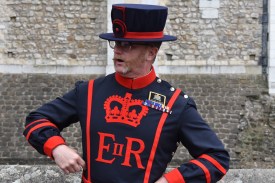 The Beefeater who ushered us around served no gin so once again I failed to get a martini, but he largely made fun of the history of the place. They are actually known as the Yeomen of the Guard, whatever that means. About 140 people, including Yeomen and Yeofamilies, live in the place where Anne Boleyn, and any number of others, were beheaded. “Mind your manners children.”
We also saw the ceremonial changing of The Word. Before there were hackers, the Tower types needed a secret word to let them know if they should do whatever it was they were supposed to do. These days, the odds of being attacked by Huns are fairly slight, but they go through the motions anyway. Every day they choose a new “word.” What else do they have to do? We watched the soldiers march around in circles and go off to tell someone The Word. Presumably they whispered. A security guard at the building housing the Queen’s Jewels (or some facsimile thereof) was standing nearby and we asked her what was going on, because The Word is so super-secret, it isn’t in the guide book.
Me: Do you know The Word?
She: Yes.
Me: What is it? I won’t tell.
She: I can’t tell you
Me: Please.
She: No
Me: I said please.
She: Sorry
Me: What was yesterday’s word?
She: I can’t tell you
Me: They’re not going to use it again.
She: I can’t tell you
Me: Your secret is safe with me
She: No
Me: Which one of those guards knows what The Word is?
She: I can’t tell you that either.
Me: You’re no help, you know that don’t you?
She: Yes
We made the mistake of buying fish and chips at the Tower because it claimed to be the original fish and chips. It was. 147 years old. Once you get past all the fried coating, the fish is about the size of your middle finger. The chips, on the other hand, are also the size of your middle finger, which is good. So, show them your middle finger and just order the chips.
There are several gift shops at the Tower of London, because, everyone has to pay for the wedding somehow. They sell something called “London Lip Balm” which I suspect is used in maintaining the famous stiff upper lip, but it looks like Chap-Stick.
We decided to take the Underground back to the hotel. We not only did not know The Word, we didn’t know how to get to our hotel. We learned that lots of uniformed folks will direct you congenially while wondering how you were able to get to adulthood without being able to read an illegible map.
The next day our mission was to shop. We wanted to 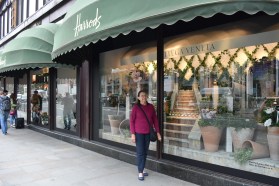 satisfy the grandchildren and a few somewhat deserving adults. Naturally, to look for souvenir t-shirts, we went to Harrods. Now, it’s taken me almost 26 years, but, I know my wife. The day was over. Pull up a chair, and let her touch everything in the entire store. Much of it is guarded by security folks, but she will touch it anyway. Somehow.
There, amongst the crystal and sterling and a two dollar Mont Blanc ballpoint pen that sold for £25,900 was a collection of coffee mugs. I love coffee mugs. When I was working and traveled to an event, I always bought a souvenir coffee mug. We have more than a few. A few cupboards full. It’s a bit of a point of contention. Let’s say I was not encouraged to add to my collection on this trip. And these were not exactly representative of our experience. They all had sayings and were aimed at the Harrod’s shoppers.
“I meant to behave, but there were too many other options.”
“Apparently the lifestyle I ordered was on back order.”
And, the only one Cheryl thought was appropriate for me; “Does not play well with stupid people.” I’ll take it as a compliment no matter how it was intended.
Unbelievably, we found no souvenir t-shirts at Harrod’s and moved on to a place called Primark. It was what Walmart would be in a third world country. On second thought, Walmart is probably already in third world countries. Like Texas. Suffice to say, it was a bit downscale from Harrod’s. On our walk there we saw any number of stores and brands advertised which were completely unknown to me. Fenty by Rhianna may be on your radar, but not mine. There was also Goopink, Boorman, Marc O’Polo and Wet Paint. Turns out that last one wasn’t a brand name.
In time we found a variety of requisite t-shirts and caps, skirts and pajamas and were on our way.
The following day we were off to Budapest. A short plane ride or two and the start of the next adventure.
Foolish boy.
First of all, Heathrow airport has the best toilets in all of what I’ve seen of Europe and America. They are clean and offer hand lotion, sanitizing lotion and condoms in both the “male” and “female” toilets. (So named so as not to exclude boys and girls I assume). And, before you ask I did not personally research the female toilets. I had an accomplice.
That’s the good news.
We got to our gate with time to spare, only to be told the flight was delayed 35 minutes. You must know that an airplane crew can’t do anything in 35 minutes. And a Lufthansa airplane crew doesn’t even show up in the first 35 minutes. Since we had time, we looked through the shops. Nice shops there. There was a Kate Spade store. I was surprised it was open, since she had committed suicide just the day before. I went in and asked if they were selling commemorative scarves. Too soon? (They were not). An hour later, we were getting in the plane to fly to Munich, or Munchen as the Germans misspell it.
Why Munich you ask? I looked at the map and from London to Budapest is about fifteen inches. Stopping in Munich adds an inch, or nine hours.
Our connecting flight was now much in doubt. We needed to get our passports checked again and get from one concourse to another. We arrived breathlessly as the gate closed. The ever-so non-communicative Lufthansa gate person stared at her computer and typed, and typed, and typed. I haven’t written as much in this blog as she typed into her computer while we stood there.
Finally she said we had been booked on a later flight. Four and a half hours later. As we waited, they changed the gate, then the departure time, then canceled it altogether. It was raining lightly in Munich and the plane could not take off. Really? No lightning, just rain. Where’s Sully when you need him?
Back in line to see what fun they had in store for us now. Another flight was leaving in another four hours and we could get on that. In the meantime, in consideration for the inconvenience, they begrudgingly gave us vouchers for €10, for which we were supposed to be grateful. That’s about $11.75. Ever try to buy a sandwich, or a drink, or a cup of coffee, at an airport with $11.75? We were about ninety dollars short.
The flight that was going to leave at 10:35 finally left at 11:10. No one at Lufthansa made an announcement, offered an explanation or spoke at all. Had we not seen a little light at the gate turn from red to green, we’d still be standing there. Through this all, there was exactly one person at Lufthansa who was pleasant.
I won’t mention that the planes were WWII Luftwaffe rejects. Dirty, old, broken down. But I won’t mention that.
Should anyone ever ask, you can tell them that Lufthansa translates to “Left standing at the airport.”
We eventually arrived in Budapest, which is not the loveliest airport in the world, but by this time we didn’t care if there was an airport at all. We found our luggage and a little man holding a sign that said “Viking.” We loved him. We lavished him with praise. We showered him with Swiss francs.
He got us to the ship where our next adventure would begin. We thought.
We wheeled our luggage to the doorway or whatever they call a doorway on the ship and a uniformed guard made entirely of East European muscle pointed to the room card entry box. I told him we were just arriving and didn’t have a room card. He seemed to understand, though the only word he uttered, over and over, was “sorry.” But, he rang a doorbell. We stood forever, while he rang the bell over and over.
It’s one o’clock in the morning. The guy who was supposed to be on duty had to get out of bed and put on his shirt and tie before he came to the doorway or whatever they call a doorway on a ship and welcomed us. We got our room cards. We got our room. Cabin. Stateroom. Whatever. He came back in a few minutes with sandwiches and fruit. We had arrived.
And that brings us to Part III.

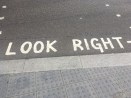 n the rest of Europe, except Malta and Northern Cyprus, drive on the right, or right, side of the road. Since that means tourists and pedestrians from civilized nations are liable to be unjustifiably mowed down right and left, there are helpful painted warnings on the street at many intersections.
 along them, most of which slipped my mind immediately. Then we docked and walked around to see other curious things about the city. The guide was quick to point out that you could buy pot in various forms at coffee shops. If the sign is in
 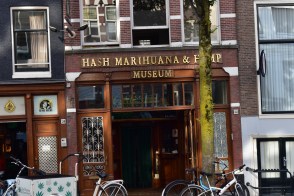 English, there is no coffee pot, just pot. If you actually want coffee, learn Dutch. That may say something about the clientele.
 After that we were on our own for dinner and found a restaurant along a canal that served a really good meal, though somewhat inefficiently, unless you like your starter as your dessert. Then we walked around a bit before getting back on the coach (don’t call it a bus) and heading to the hotel.
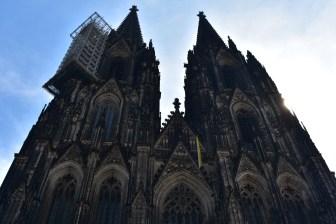 Almost everything old, which is to say almost everything, is covered by scaffolding. Yet, for all of that, never once—not one single time—did we see anyone working on any of that scaffolding. Apparently, they put it up and figure that is good enough. Note to self: Invest in scaffold companies.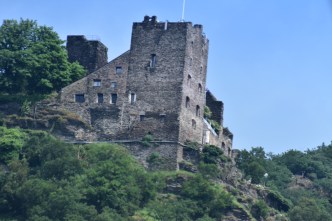
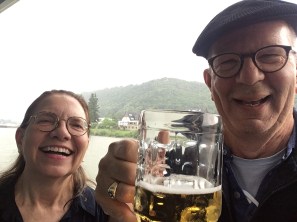
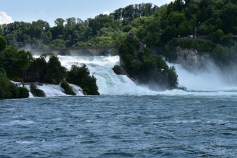
 Tour. We stopped for lunch at a place that was also a cuckoo clock store. Very elaborate cuckoo clocks. So-so lunch. And later a stop at Rhein Falls. Not a huge waterfall, but a nice scenic spot.
 guilty about sleeping because I might miss something, I learnt that the highways are lined with trees so there is nothing to see except asphalt and white lines. There are no Botts dots in Europe, by the way. The highlight of the highway in Germany are the signs that say “Ausfahrt.” It’s not a pay toilet protest thing – it means “exit.” Interesting for an exit or two, but after that, only if you’re twelve.
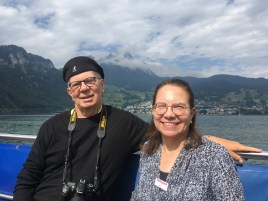 We took a boat across Lake Lucerne to get to the base of Mt. Pilatus, which, despite what you might assume, is not the place where Pilates was invented. (One day, take the time to read the Wikipedia entry on Pilates. It essentially says Pilates doesn’t live up to any of its claims for improving health and fitness and is only slightly better than doing nothing.)
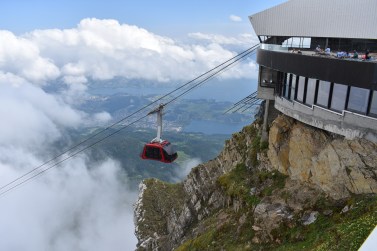 which had nothing to distinguish itself, other than its somewhat perilous route. At the top of the mountain, nothing but gorgeous green Switzerland.
 News, to Me