All I Know

As a kid, I was filled with misinformation.  Not just the normal kid misinformation like mud is good to jump in and dogs like to have their tails pulled.  I thought the signs pointing to “frontage road” were directing cars to a street named Frontage; like First Street, Washington Avenue and Frontage Road.  It wasn’t until I understood there had never been an explorer, developer or president named Frontage that I realized it was just the nondescript street leading to the strip mall.

When people said “no news is good news,” I thought it meant there was no such thing as good news.

For a long time, I thought Spago, Drano, Pepto and Bromo were the names of the least talented of the Marx Brothers.

Fortunately I lived next door to a kid who knew everything.  And this was before Google. I know he knew everything because I asked him.   In high school, he once (at least once that I heard) made an offhand reference to some totally obscure fact that no one else could possibly have known.  I looked up and asked, “Tom do you know everything?”

Without a moment’s hesitation he said “actually, I don’t know anything at all about hydraulic pumps.”  I figured he was just being modest, because as he explained what it was he didn’t know about hydraulic pumps it was clear that he didn’t know less than I didn’t know.  I didn’t…and still don’t…know enough about hydraulic pumps to know what I didn’t, and still don’t, know.

For that reason and others, I’ve always found it easier to quantify what I do know than what I don’t.  On our first date I told Cheryl there were only four things in the world I knew anything at all about.  I said I knew a little about television news, a fair amount about golf, a great deal about college basketball and absolutely everything about embalming.

That led to a long discussion about growing up as the son of a mortician, but she went out with me again anyway.

I’ve clung to that claim, though the order has changed now and then. For most of my adult life it was exactly reversed.  Now I don’t think I know much at all about any of those four topics.  I am far removed from the ins and outs of embalming, as it were, though I am closer to being embalmed than I ever have been.  (Not that I’ll learn anything from the experience).  I don’t follow college basketball well enough to get into a Final Four pool any more, even though every college team in the country now makes it into the tournament.  I’m playing golf whenever I can and follow the game somewhat, but it’s been a long time since I was able to name the player of the year for every year of the decade.

And television news? Well, despite spending thirty years working at it, I’m fairly out of touch with it now as a profession and don’t really even watch it very much.  I can expound upon how it used to be done, back when we did it well – or at least as well as it’s ever been done.

Perhaps most disturbing is that nothing has crept in to fill the cranial voids.  I just know less and less – stuck with dwindling levels of expertise on four subjects and an urge to read up on hydraulic pumps.
Dentist

I went to the dentist this morning and it struck me (though not literally) what an arcane experience that is.  Yes they can take x-rays without developing films and they can drill without filling your mouth with hoses, nozzles and vacuum tubes.

But this was just a cleaning and it is the least high tech thing that is done at a dentist’s office, with the possible exception of the three month old stack of magazines in the waiting room.

When the dental hygienist hygienes your dentistry she still scrapes away at your enamel with wires attached to a stick.  And I’m not sure why.  I don’t use a sharp piece of metal when I clean my teeth.  I do use a piece of string, which is another ridiculous ritual altogether.  And I have to admit I don’t really know what she’s doing.  All I can really see, after all, is what’s reflected in her glasses which means there’s a limit not only to what I can see but also to how much I care.  I hear the scraping and the occasional vacuuming but beyond that I neither know nor care what is going on.

There does come the moment when the hygienist’s assistant comes in to the cubicle and they turn a great deal of attention to my gums.  Now the sharp piece of wire is poked into my gums while the hygienist calls out numbers.  When she’s done, she asks if I know what that all means.  Since she does it twice a year and has for several years I’ve got a pretty good idea what it means.  But she asks anyway.  And I answer anyway.  I unfailingly answer “yes I do.  It means I’m twelve under par.”

She laughs, unfailing.  It’s part of the ritual.

I may be alone in this, but I don’t mind going to the dentist.  I’ve been going to this particular dentist, with a break of about six years when I moved out of town, for thirty years.  Unlike many of his patients, we haven’t talked much.  For one thing, my mouth is usually pried open and filled with his hands.  And truth be told, I don’t talk much to anyone.  Cheryl’s been going to my dentist for about six weeks and knows more about him and his entire staff than I have learned in thirty years.  There’s no real surprise in that.  Either.

Anyway, this whole dental teeth cleaning ritual thing mystifies me.  It seems primitive.  Maybe not primitive, but un-evolved perhaps.

We should be able to do better.  But at least we do what we do.  If we didn’t we’d be uncleansed, unsophisticated.  We’d be British.

Food

I am by actual count one of fourteen people in America who has never eaten a peanut butter and jelly sandwich.  Never.  I like peanut butter sandwiches (creamy, not crunchy) and I like jelly sandwiches.  The two together just don’t seem right.  People have argued.  Told me how much I am missing.  But I’m resolute.  Not something I want to try.  And since I’ve come this far – this long – without trying one, I won’t start now.  Among other reasons, if I did, this column would be one paragraph shorter.  (Which would not necessarily be a bad thing, but not enough reason to change my taste in sandwiches).

I was in my mid-fifties before I had a tuna salad sandwich.  I wasn’t impressed.  Not that I oppose tuna.  It’s very good, especially raw or barely cooked. Fish is so much better when it is slightly undercooked.  Put it on a warm plate, give it to a slow waiter and have him walk through a hot kitchen.  My Dad hated tuna, so we never had it in the house.  In Minnesota, tuna was a gloppy concoction in a can generally called tuna fish.  And as that‘s all he knew of tuna I can’t say as I blame him.

By the way, why is it tuna fish?  Is there some redundancy necessity?  It’s not t-bone cow or ham pig.  And it’s not an aquatic vertebrate anomaly; it’s not salmon fish, even though in Minnesota salmon was also a gloppy concoction in a can.  It was generally served mixed with bread crumbs and baked in a pan as salmon loaf.

But beyond that, I’ll eat almost anything.  Yes, I gave up meat in 1985 largely as a cholesterol thing.  Or so I’ve always said.  If it was really about cholesterol I would have given up ice cream and chocolate too, and then shot myself.  Truth is I gave up meat, which is to say red meat, anything that once stood on four legs, because a girlfriend didn’t eat meat.  So I thought it would get me somewhere if I stopped too.  A year later, when she dumped me, I couldn’t digest meat and still can’t.  I’ll eat something with meat in it once in a while, and my stomach will do the talking for me for the next day and a half.  And it is a cholesterol thing, now.

So I haven’t ordered a burger, fries and coke since McDonald’s advertising campaign was about how clean their stores were.

Grab a bucket and mop

Scrub the bottom and top.

Tell me what does it mean

At McDonald’s it’s clean.

All right, so with those few exceptions – peanut butter/jelly and tuna salad sandwiches, beef, bacon, ham, pork, mutton, veal, lamb, goat, deer, moose, elk, horse, buffalo, dog, cat, llama, camel, elephant, rhinoceros, hippopotamus, coyote, fox, wolf, tiger, lion, rat, mouse, chipmunk, squirrel, dingo and koala – I’ll eat anything.

Except grapefruit.  I like grapefruit a lot but it’s a cholesterol thing.  A cholesterol medication grapefruit reaction destroy your liver thing.

When I was in second grade our parents went on a vacation with the Blanchards and spent ten days in Florida.  They left my brother and me with our neighbor Bertha who moved in to take care of us.  Every morning she would cut a grapefruit in half and sprinkle it with liquid Sweet-10, a sugar substitute that I think advertised that one drop was equal to ten pounds of sugar.  So with a liberal drenching of Sweet-10 on our grapefruit it was gaggingly sweet.  We hated it.  Isn’t tart the whole point of grapefruit?

Not only that, but she didn’t use the curved serrated knife Mom used to carve around the rind and separate every section.  She just doused it with Sweet-10 and served it to us.  That left us to poke at it with a spoon and leave it a mangled, partially dissected sickeningly sweet mess.

As good boys, it never dawned on us to tell Bertha we didn’t like our grapefruit that way.  Instead our solution was to hide the Sweet-10.  But because I was in second grade and my brother in fifth, we hid it in the same cupboard where it was supposed to be.  Had we been older, or more cunning we would have put it in our parents’ dresser or in the garage.  But we put it in the back of the cupboard and every morning she found it and destroyed our grapefruit again.

It’s not eating unusual things that bothers me.  I like that. We didn’t have a lot of “unusual” food in Minnesota. Unless you count lutefisk.  That’s about as unusual as it gets. But by and large it was a pretty meat and potatoes place to grow up. I never saw an avocado or artichoke in Minnesota. Most of the year our fruits and vegetables came from a truck. If they were fresh when they got there, they had started their trip very, very green.  Most often they were in a can or frozen in a block of ice, which was okay because much of Minnesota was frozen in a block of ice.

So people went looking for flavor elsewhere.  I grew up among people who put sugar on tomatoes.  Tomatoes were to be eaten with salt and pepper.  Everyone knew that.  I’ll admit to salt on watermelon, but not sugar on tomatoes.  And most vegetables were better with a can of cream of mushroom soup poured over them.  That’s gourmet.

Rain

This is serious. You may not think so, sitting in your comfortable little cocoon wherever you are, but this is serious.  It’s raining in San Diego.  It is not supposed to rain in San Diego in November.

The television stations are forced to use last year’s StormWatch graphics.  And that’s not all.  The rain is causing traffic accidents.  It’s inconveniencing peoples’ lives.  It will be dripping on people who weren’t expecting it.

San Diego expects rain January and February.  A bit.  Not on weekends of course. But now and then.  Certainly not in November.  Why is this happening?  Who would do this?  There’s a time and place for rain, but in these economic times, this is not the time.  We need to balance the need for rain against the economic needs of society.

Rain washes dirt and trash downstream, until it finds its way to the ocean.  And it makes the water unfit for swimming for three days.  The entire weekend.  Not that most of us want to go in the water in November anyway.  We know it’s too cold.  But there are people here vacationing from places like Nebraska and Indiana and they long to sit on our beaches and frolic in our ocean water.  The rain and runoff (the Chamber of Commerce has taught us not to say pollution) prevent them from enjoying the bounty of our land and spending their hand-delivered stimulus money.  Not that the stimulus was a good idea, but once the money was available, they may as well take it.

We understand there’s a need for a little rain.  Rain should fall between three o’clock and five o’clock in the morning.  Some mornings.  Not all.  And not hard rain.  No thunder.  Not any rain loud enough to wake hard working Americans from their well-deserved sleep in their comfortable beds.  Socialists will say this early morning rain will harm the homeless and a few truckers making early deliveries, and let them complain.  We know that argument won’t really hold water, so to speak.  It will gain little sympathy.  And the overnight rain will screw with those annoying Occupy people and that’s as it should be.

Overnight rain will be enough to keep the grass green and the plants alive.  And that’s all we need.  When the sun rises in the east it should rise over a cloudless sky, beaming bright, beautiful, radiant, warm, carcinogenic sunlight.  That’s the sort of weather that creates jobs, promotes wholesome outdoor activity and keeps people happy.

No one smiles in the rain.

It’s raining and there are outdoor weddings planned.  Festivals, farmers’ markets, soccer games and golf. It’s Beer Week in San Diego.  Craft brewers from all over the country are here to pour beer. Beer gardens, beer tents, beer events – most of them planned outdoors, because this is, after all, San Diego — and now it is all sabotaged by rain.  Hundreds of thousands of dollars of hotel and restaurant revenue lost to the rain.  It’s big business. Waiters and waitresses idled, jobs lost, temporary workers turned away.  Too much rain.  It’s costing us jobs.  In this economy we cannot have rain.  It’s just that simple. This is unconscionable.

Fucking Democrats.


2016: The In Crowd

Pundits are back pedaling so fast on their predictions for the Republican nominee for President that they are bumping into themselves coming forward with new predictions.

There were the “don’t underestimate Michele Bachmann” pundits, the “Sarah Palin must be running because why else would she be doing this” pundits, the “Huckabee has a lock on the Christian right” pundits, and the “(fill in the blank) will surprise a lot of people” pundits.

Standing apart, in a swirling sphere of his own is poor, hapless George Will.  In 2007 Will said that the candidate who had a lock on the Christian right and was the one to watch for the nomination was Sam Brownback, who dropped out after the Iowa Straw Poll.

In 2010, Will said the clear Republican choice to challenge and defeat Barbara Boxer in California was Chuck DeVore who finished third in his party’s primary to Carly Fiorina and Tom Campbell. Boxer went on to handily defeat Fiorina.

This year Will had his act together.  And he knew as early as May.

 “This is the most open scramble on the Republican side since 1940 when Wendell Willkie came out of the woodwork and swept the field.  I think — people are complaining this is not off to a brisk start. I think that’s wrong. I think we know with reasonable certainty that standing up there on the West front of the Capitol on Jan. 20, 2013 will be one of three people: Obama, Pawlenty and Daniels. I think that’s it.”

George Will is the Sports Illustrated cover of political punditry.

I’m not going to claim to be of that caliber.  I’m not going to claim to have any political acumen at all.  But if you look at the trend, you can see who will be a serious contender for at least a day in 2016.

Mayor Bruce In of East Fairmont Oklahoma.  Never heard of him?  Doesn’t matter.  It’s all about the trend.

In 2008, the Republican nominee was John McCain.  Right now the Republican frontrunner is Herman Cain.  Doesn’t take a genius to spot the trend:

McCain – [Mc]Cain – [Ca]In.

Being mayor of East Fairmont isn’t a full time job.  It does pay ten dollars a meeting, but a fellow needs a little something more to sustain himself.  Mayor In is a dentist. And don’t try to trip him up with fancy reporter “gotcha” questions.  He knows all the ways to twist the “the doctor is in” joke.

Is the doctor In?

Yes.

May I see him?

He’s not here.

I thought you said he was In.

He is.

Well then I’d like to see him.

He’s out.

He’s out?  I don’t understand.

What’s there to understand?  In is out.

In is out?

That’s what I said.

And I suppose Black’s white and Wright’s left.

As a matter of fact…

Do I expect the professional pundits to spot this trend and get In on it?  Will won’t.

The Day After

It’s been a full day since I gave up the mantle as President of the San Diego Press Club and I’ve had time to reflect and write my memoirs.

It was a crisp morning and I woke feeling tired yet buoyant, as though a weight both physical and psychic had been lifted from my shoulders.  When the dog and I went for our walk, I was struck by the quiet.  No one was clamoring around to get a word with me, take a picture or ask for an opinion.  We walked quickly but I breathed in the fresh air and felt exhilarated. Still, there is a certain sense of a loss of purpose and direction that is both foreign and liberating.

Yes it was odd going out to the car and having to drive myself.  Out of habit I sat in the back seat and when I realized no one was coming to drive I moved somewhat sheepishly to the front.  There were very few phone messages to return and much of the day was spent just gathering up mementos.

The real work of collating my papers will start soon, though much of it is already in order.  I was fairly meticulous through my term in keeping things in a binder.  Twelve meeting agendas with my handwritten notes will provide guidance to some future administration.  Today was for reflecting a little and also looking ahead, searching for a new mission.  The work of fundraising to construct the presidential library shelf will start soon enough.

Pens

I always carry a pen.  Always.  OK, not in the shower.  Well, not on the golf course either, but then I have a pencil. My pen is on the bedside table, though there may not be paper there.  But otherwise, always.

Some people call them ink pens, which I always thought was redundant.  But maybe they feel the need to distinguish their pen from the one that encloses pigs or prisoners.

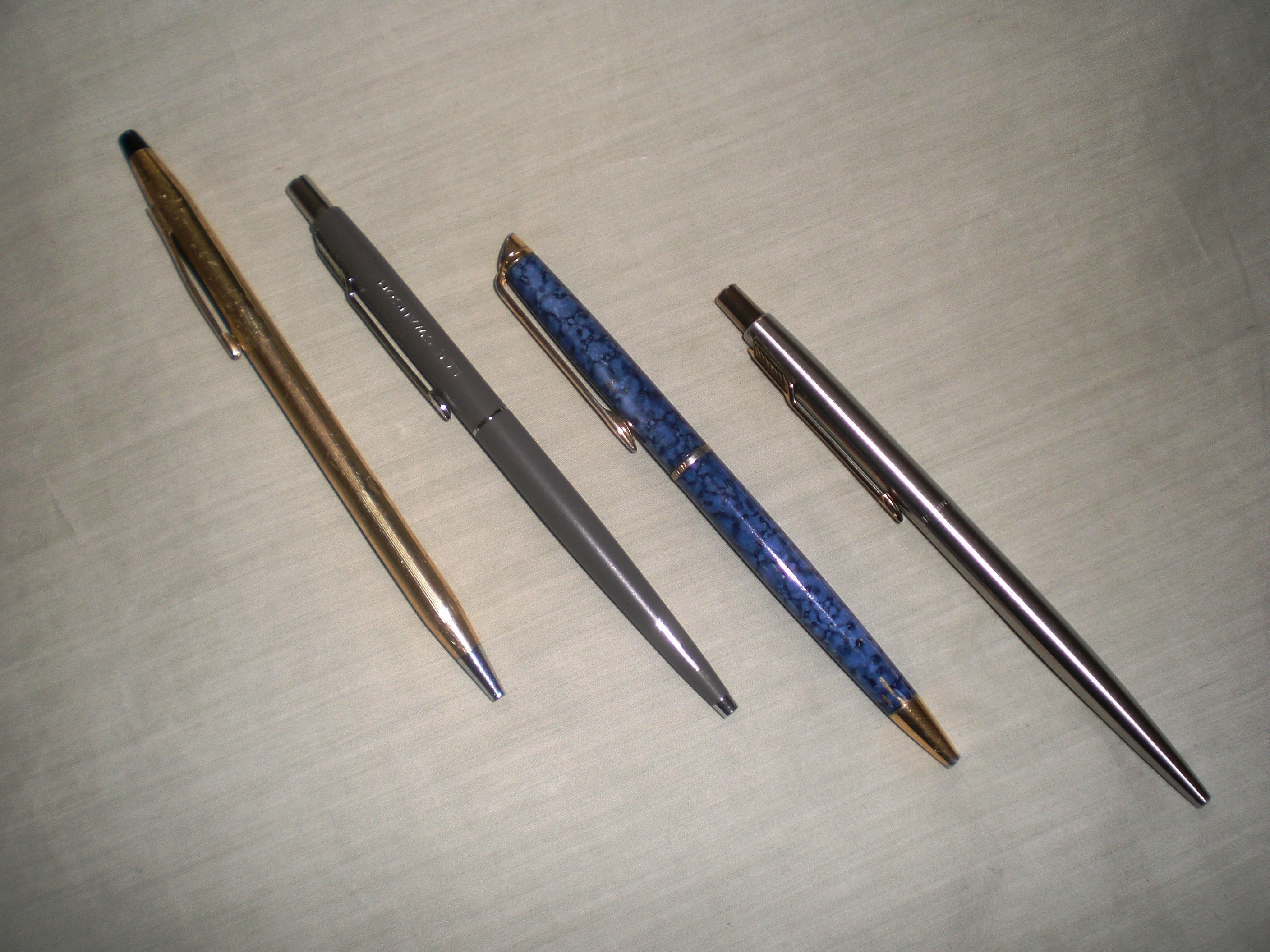
When I was sixteen, my parents gave me a gold Cross pen.  It was the first good pen I ever had and I still have it.  I carried it in my shirt for more than twenty years.  In my shirt, but not in my shirt pocket.  I put my pen in the placket of my shirt, between the second and third buttons.  I never put it in the pocket.  When I used to wear ties, the tie would cover up the pen.  On one of our trips to Thailand, I had dress shirts made for myself, and I had them made without a pocket.

One day when I lived in Portland Oregon I was running across the street in the rain and the pen fell out of my shirt and I stepped on it.  I didn’t know it had fallen, but I felt it when I stepped on it.  Crushed it pretty badly and it wouldn’t turn to retract or extend the point of the pen.

Fortunately, when I was best man at a friend’s wedding he had given me a Parker pen and pencil set with my name engraved on the barrels.  So I replaced the Cross with the pen from the set.  Never really used the pencil.  I carried that pen for several years until one day I dropped it in the car and it wedged into that little crevice between the driver’s seat and the console, next to the railings that move the seat back and forth.  It’s impossible for me to get my fingers down there and still keep them attached to my hand.  I tried lying on the floor in the back seat and reaching under the seat and I could touch the pen but I couldn’t move it.  So I took a coat hanger and went fishing for it.  I got the pen out but managed to scratch up the finish of the pen pretty badly.

Since it was as much a keepsake as it was a pen I put it in the drawer so it wouldn’t get any more scarred than it already was, and I bought a Waterman pen.

I carried this pen until about a year ago when it simply disappeared one day.  It wasn’t on the dresser, the bedside table or in my shirt.  Those are the only places a pen belongs and it wasn’t in any of them.  After I looked where it should have been, I looked where it should not have been; one or two of which I should not have been either.  It was nowhere to be found.

I was a little upset, but I was more angry than anything.  Obviously I don’t lose things.  I particularly do not lose pens.  But I couldn’t find it and I had to have a pen so I bought another Parker.

Then one day Cheryl took the grill off the front of the refrigerator to vacuum the lint out from in under it, and out came my Waterman pen.  A little dusty but none the worse for the experience.   My four pens

So now I have them all; the four pens of my life.  At least the past forty-four years of my life – and counting.

You might think that since I always have a pen that I do a lot of writing.  Aside from taking notes on phone conversations and signing birthday cards and credit card receipts, I probably don’t use a pen for much.  I don’t remember the last time I used my pen to write a letter.  I learned to compose my thoughts at the typewriter when I was in journalism school and have been writing at a keyboard ever since.

And I imagine the pen’s days are numbered.  It will go the way of the typewriter, the slide rule, 45’s, film and VHS tape; replaced by the iSomething.

It is increasingly difficult to find refills for my pen.  Drug store clerks look at you quizzically if you ask for a pen refill.  Even some stationery stores don’t carry them though you would think that if anyone had a vested interest in selling ink it would be the store that sells paper.

Which makes me wonder how much longer the ink supply can last anyway?  I suspect there will come a day when it’s just not economical to drill for ink any more.  When it was just us pen users who needed ink the supply seemed endless.  But then came the typewriter, printing press, adding machine and now every house probably has a printer next to its computer.  That’s an enormous amount of ink coming out of the ground.

When they sink an ink drill into the ground the first ink to come up is red. It is closest to the surface. But since it is only used by teachers and accountants there is not much demand for red ink so the drillers usually press on.  No one is exactly sure why ink changes color deeper into the earth, though it’s obvious that it does.  Soon, the ink turns dark blue.  There is a gigantic pool of blue ink.

Deeper still is the black ink. It is the oldest ink and the most difficult to bring to the surface. And it is used for just about everything.  I use black ink in my pen.  Always have.

I’ve had people try to tell me that you can’t drill for ink, but those people have obviously never heard of an ink well.

Car

Let’s just get this out there right up front:  I drive an old car.  Not one of those highly polished, fully refurbished, driven-only-in-parades old cars.  This is just a car that is old.

How old?  It has a hole in the driver’s door where you can poke in a key and turn it to unlock the door.  There are no buttons on the key chain that make the lights flash, the horn honk, the car chirp and the doors open.  There’s no USB port, iPod connection or LED screen showing me what I’m hitting when I back up.  The spot where the cigarette lighter is supposed to be has a cigarette lighter.  It doesn’t have a CD player; it has a cassette player.  And I have a cassette.  A couple of them in fact, because I have a cassette player.  No soothing voice tells me where I’m going or whether I’ve taken a wrong turn.  The only voice I hear when I drive is Ira Glass, unless I’m talking to myself (which happens more often than it probably ought to).

There was a period of time when mine was the only voice I heard in the car.  The motor that moved the antenna up and down broke and radio was mostly static.  I’ve heard myself talk and frankly I’m not that interesting so I looked in to getting the antenna fixed.  They wanted three hundred dollars.  So I went to a parts store and bought a generic antenna.  It gets a clear radio signal, but it doesn’t go up and down.  It also doesn’t quite fit on the rear left fender.  I put it up but after driving a few blocks down the street it’s fallen over and is horizontal, pointing out like a curb feeler. Except that instead of guiding me to park the ideal distance from the curb it’s poking the parking meter in the quarter slot.

The car needed a little help studying for its smog test and I began wondering if its parts weren’t worth more than the car.  I drive a little slower past dealerships now, looking at gleaming metal and sparkling glass and wondering what it would be like to have a car that gets noticed for all the right reasons.  Just a couple of weeks ago my old car turned 200,000 miles but its mechanic assures me it has plenty of life left in it so I’ve decided to drive it until it stops.  I’m not keeping it because I am at all sentimental about it. The car doesn’t have a cute name, hasn’t been waxed in years and is washed only when I can no longer see out the windshield. So if I go out tomorrow and it stops in the middle of an intersection, I’ll push it to the curb, slip the house key off the ring, take the golf clubs from the trunk and walk away.

Then I’ll be the owner of a car that isn’t an embarrassment to me.  Probably.  It also won’t be paid for.  I don’t remember the last time I made car payments, but I’m pretty sure my feeling toward them has something to do with why I drive an old car.

Fashion Advice

There’s a guy I often see in the morning when the dogs take me for a walk.  He wears a blue t-shirt, work boots, black socks, denim shorts and clip-on suspenders.  The suspenders just sort of top it off.  Big, wide suspenders clipped to his shorts. He’s a short, round little man and in a couple months he could trade them in for red suspenders and get a job at any department store on earth, except that he rarely says anything more than “hello” and even that only grudgingly.

Looking at him as he came down the street this morning I couldn’t help but wonder, “does he think that’s a good look?”

I, on the other hand, wore my usual morning walk uniform — running shoes in which I’ve never run, nylon warm up pants and a white t-shirt with some sort of logo on it.

One of the advantages and disadvantages of a lifetime in television news is a large collection of free t-shirts and caps. Advantage because I haven’t had to buy a t-shirt in a long time, maybe ever. And disadvantage because many of them have dates on them.

Today’s shirt, for instance, was “ABC News – The Vote 2004” – from either the Democratic convention that nominated Kerry and Edwards in Boston or the Republican convention that re-nominated Bush and Cheney in New York.  I was at both and don’t recall where the shirt came from.  I do remember coming away from New York firmly convinced that there was no way in hell those two were going to get re-elected.  It was the same feeling I had four years earlier in Philadelphia as we watched waves of henna-headed women stand beneath the podium and chant “Bush and Dick.”

The t-shirt drawer is pretty full.  And there’s a stack of baseball caps in the closet at least three feet high.  I look at that stuff and I’m sometimes reminded of the farmers where I grew up.  No farmer in America has ever bought a cap.  And not many bought jackets.  The joke was, “why don’t farmers wear tennis shoes?” “Because seed corn companies don’t give them away.”

So, now as I walk down the street, anyone who bothers to notice knows my t-shirt is seven years old. Not the worst fashion statement and not even the oldest piece of clothing I own.  There’s a sweater from the 1982 U.S. Open at Pebble Beach, for instance.  It’s been well cared for and is in pretty good shape.  Invariably when I wear it, someone will look at the logo and say “I wasn’t even born then.”

But I’m ready for them. “This ‘old’ sweater,”   I point out “is from the U.S. Open where Tom Watson made what’s no doubt the most famous golf shot in the history of the Open, the iconic chip shot from the rough behind the 17th green for birdie to win the championship and defeat Jack Nicklaus.  And I was there.  Saw it with my own two aging eyes.  And, because photo credentials were easier to get in those days, have the picture to prove it.”

They invariably look at me, shrug and say “yeah, well it still kinda fits.”

Smart ass kids.

Blackout

I learned a lot during a power blackout here in San Diego the other day.  The whole county, parts of other counties and part of Mexico were without electricity.  “Plunged into darkness” as the newspapers would have you believe.  Truth is, the darkness came at about the same rate it usually does, it just wasn’t artificially supplemented.

The blackout started in the afternoon long before dark set in and the neighborhood parties got going and it was informative to watch people try to get home.  All the stop lights were out and cars were backed up blocks long all over the city.  But at least on the city streets I was on, people were patiently waiting their turn.  No horns and shouts, no cars sneaking across the intersection to try to get ahead of others.  Everyone seemed to know that each car had a right to go across the intersection and everyone let them get there.

And it got me thinking.  Maybe stop lights aren’t such a good idea.  Almost everyone seems to run the yellow lights, if not the red. If there’s no light, and no stop sign, people seem to do pretty well at being cooperative.  I know, I know, it was slow and cumbersome.  But in due time everyone got where they were going.

It was civilized and considerate.  Everyone agreed without argument; without even discussion. But more than traffic control, I’m wondering  what can we do to get a blackout on Capitol Hill?