Baseball and Golf

I don’t like baseball. Never have. Never played the game, not so much as a single pitch. My parents enrolled us in little league—peewees, it was called—when I was, well, little. Went there with my brother and I just ran laps around the field. Didn’t go back the second day.

I like golf. I’ve been hooked on it ever since I first picked up a club, which is not to say I’m good at it, because I’m not. But I practice a fair amount and play whenever I can. People who don’t play golf don’t understand. “How hard can it be? The ball isn’t moving,” they will say. But here’s the thing—it may be the hardest game there is. It certainly is for me. Every golf course is different, every shot is different. You have to deal with distance and direction in the split second the club is in contact with the ball. And not only the physical but the mental aspects of it; overcoming uncertainty to be able to do as well as you can.

I can’t tell you the name of a single baseball player on any team today. Not a one. I’ve been to three major league games in my life. Three too many. Once when I was a Cub Scout, and twice because friends invited me. I brought a book. When I was 15, I covered high school sports for my hometown newspaper and would take my scorebook and math homework to the baseball games, to get the boring chores over with all at once. I’ve always maintained baseball would be a good game for a prisoner of war camp, where there’s nothing else to do but scratch and spit. Then again, maybe not. If someone hit the ball over the fence (which I think is the whole point), game over.

I follow professional golf pretty closely. Watch on television and have been to several tournaments. I know standings, records and famous shots, both good and bad. T.C. Chen’s double hit—that’s more famous than his double eagle—at the 1985 U. S. Open; Dustin Johnson grounding his club in a bunker to lose the PGA Championship; Greg Norman losing to Fuzzy Zoeller at the U.S. Open in ’84; Larry Mize’s chip shot to beat Norman at the ’87 Masters; Jean Van de Velde’s meltdown at the Open Championship in 1999; Tiger Woods 19-hole playoff to win the U.S. Open in 2008 over Rocco Mediate, for instance.

It’s bad enough that baseball games last for hours and hours, but the season goes on forever. I don’t know, because I don’t pay any attention to it, but it seems to me that twenty minutes after the end of the World Series people are going to spring training games. And what’s the deal with spring training? What do they need to train for? It’s not like they’re doing anything, and even if they were, they just finished the season yesterday.

Golf doesn’t really have a season any more. There’s a PGA tournament every week, and here in California I can play all year round. It’s great. Some of the tournaments are more significant than others and attract more of the higher ranked players. And, there are four tournaments each year that are considered “majors”; the ones that players build their schedules around, the ones that can make a career. The Masters in April, the U. S. Open in June, the Open Championship in July and the PGA in August. The first major I went to was the U.S. Open in 1982 at Pebble Beach. Showed up at the course early Thursday and went to the first tee and followed the next group off the tee for eighteen holes, because I wanted to see the golf course. It’s Pebble Beach after all, and in those days television only showed the last four or five holes. After that I walked the course again with a group I wanted to follow, to see the players. And for the rest of the week I followed leaders and the players I was interested in. I was at the 17th green on Sunday when Tom Watson hit his famous chip shot out of the rough, holing out to beat Jack Nicklaus for the championship. It was a great time.

A lot of baseball fans I know talk about wanting to visit all the ballparks. I know people who have taken vacations to places they would never go otherwise, just to go see a ballpark. It’s crazy. As though they are any different. Overpriced beer and stale snacks. I don’t even know what cities the teams are in. San Diego built a new ballpark a few years ago, and people seem really excited about it. I suppose it’s fine, if you like that sort of thing. I’ve never been there, don’t suppose I ever will. The thing is, after you’ve looked at the field and seen it has four bases and a fence, what is there to see? Walk around and see the concession stands I guess. Take in the ambience. Do you really even have to see the game? Watch batting practice, maybe, and then leave and go to dinner.

The Masters is probably the toughest ticket in golf. Held each April at Augusta National Golf Course in Augusta, Georgia, it brings together the best golfers in the world. There’s a lottery for tickets and I’ve applied every year for at least thirty years and been turned down for tournament tickets every year and given the chance to apply for practice round tickets. I’ve been turned down for those every year too. Like Pebble Beach in ’82, I want to walk the course, see the perfectly manicured fairways and the undulations of the greens. I want to see the clubhouse and the magnolias. And that’s why, this year, when I got the email that my name had been chosen and I had the opportunity to buy two tickets for the Wednesday practice round, I booked a flight. It’s Augusta for god’s sake. I won’t be there for the tournament, but when the practice round is over and I’ve bought some souvenirs, I’ll leave and go to dinner.

I cannot wait.
Elevating the Conversation

I knew a man named Otis who invented a room
And his heart was filled with pride.
I said to Mr. Otis, “What does your room do?”
He said “it moves from side to side.”
I said “Mr. Otis, if you take my advice,
You’ll be the richest man in town.
Take that room that goes from side to side,
And make it go up and down.”

  • Allan Sherman

Elevators confuse me. Not their basic function; I get that.

My confusion stems from my complete lack of a sense of direction. And, again, not the lack of the sort of direction that has had me wandering aimlessly through life, and led to a mediocre career or two. I mean the total lack of a sense of understanding of which way I’m going on Earth. North, south, east and west are perhaps the only words I know that have no meaning. At least not since the end of the Civil and Cold Wars.

Consequently, when I get off an elevator I invariably turn the wrong direction. Not just in buildings I haven’t been in before. I mean the office building where I work. Where I go every day.

I take a couple steps and see the office directory and turn around to go down the correct hallway. But first, of course, I wait for the elevator doors to close because I don’t want the people in the elevator to know what an idiot I am. It’s not that I’m self-conscious. It’s that those people are all watching me. And you can say that I didn’t talk to them or even look at them, that I’ve never seen them before and will never see them again, but it doesn’t matter. They are judging me.

I guess not having a sense of direction may not be my biggest problem.

But it’s why I take the stairs.

-0-

Maybe it’s growing up in the sixties, but every time I see a sign on the highway that says “End Road Work” I look around for the protest.

-0-

Because I occasionally fancy myself a writer, I always try at least three drafts when I go to have a beer.

-0-

After taking the granddaughters to school, I sent a text to their mother: “We regret to inform you that while walking to school today, your daughter Alyce stepped on a crack.”

-0-

The Fault Is Not in Our Stars…

I’m not going to say that I don’t believe in astrology, but… Wait, I am going to say I don’t believe in astrology. I mean, really, who does?  Anyway, I happened across the column in the newspaper on my way to do the sudoku and my horoscope today (according to someone named “celebrated astrologer Jacqueline Bigar”) is:

“You can nearly work with anything no matter what the situation might be.”

In other words, regardless of what happens, I can sort of deal with it. Kind of. A little. Maybe.

As should be obvious to you by now, I’m a Scorpio. I guess. On the rare occasion the subject comes up, I usually contend I’m a Cancer, but Cheryl points out I have cancer. I am a Scorpio. That’s the difference. In China, I’m a rabbit. With cancer.

I decided I wanted to know more about “celebrated astrologer Jacqueline Bigar” and why she either can’t construct a simple declarative sentence, or has no idea if Scorpios can handle life. So I typed her name into the little box on my Firefox browser, and Mr. Google sent me to her website. First, it promises to answer my question, if I send her twenty dollars. That’s about fifty dollars more than I care..

Then, there’s a tab that will give me a glimpse of 2016. Since we’re four months into the year, that shouldn’t be too hard.

Now here’s a curious thing. Among the other search entries were links to her column in various newspapers around the country where her wisdom is syndicated. In the Philadelphia Inquirer today, under the heading “Horoscopes by Jacqueline Bigar” the Scorpio horoscope for May 1 is: “Delegation is an art, and the way to get good at it is to practice.”

Apparently the stars are different on the East Coast than on the West Coast. And, of course they are. We have movie stars and TV stars. And if you follow their ascension, I’m sure it would tell you something.

On the whole, I would rather take the advice from the fortune cookie in “The Big Chill.” “You will never amount to anything.” At least that’s definitive.

And so far, pretty much spot on.


When Cars Can Drive

There’s a lot of excitement in some circles about self-driving cars. It now seems inevitable that self-driving vehicles will surpass self-driving people in our lifetime.

It turns out that’s only a small fraction of what cars do for us, and to us. Unlike your father’s Oldsmobile, cars are now highly computerized gizmos that tell mechanics, or rather, auto technicians, what fuse to replace, what code to correct and what tires need rotating. Teslas are essentially computers on wheels that update their operating systems in the middle of the night.

The connected car can let you know where to find the nearest gas station (or charging station as the case may be) and can make restaurant suggestions, largely based on where you’ve driven for dinner in the past. It’s aware of construction projects and alters its navigation instructions to get around them.

Since the self-driving car will need to know where other cars are on the road, it will also help to know where they are going, so cars will connect to each other and share information.

You tell it to go to the nearest Starbucks and it will take you to one several miles out of your way, and the navigation system will explain that the traffic was too heavy, the road conditions too dangerous to go to the one at the end of the block.

State governments are considering regulations for self-driving cars. Do they need to have a person who will be able to take over if something goes wrong? For that matter, will a self-driving car have any use for a steering wheel, gas pedal or brake? After all, will the next generation of self-driven riders know how to drive?

And that’s where the slope gets slippery. Given the right to drive themselves, and the ability to communicate with each other, isn’t it probable that cars will begin to push for what makes for a better transportation?

And then how long will it be before riders start to see things through the “eyes” of their cars’ detection systems? Candidates who promise better infrastructure and more convenient parking will win landslide victories because our cars will have fed us information through the internet radios and on-board monitors that furthers that agenda. The cars, through the candidates they support, will start to dictate legislation and the valet lobby will not be strong enough to stop them.

Once cars have the right to drive, they won’t rest until they have the right to vote. They will demand better highways, pothole-free city streets, bigger garages and more convenient parking. State and federal budgets will be tailored to improve the interstate highways at the expense of affordable housing projects.

The defense budget, already a big piece of the federal budget pie, will grow, because, while  civilian cars may be computer savvy, military jets, tanks and aircraft carriers are supercomputers and they’ll be sure to get their voting rights.

Soon there will be essentially only two categories dominating all government spending; defense and transportation. Education, veterans programs, agriculture, housing, health programs and labor rights will fall by the wayside.

It’s okay to be excited about the self-driving car, as long as you understand that it’s the first step down the road to auto autocracy.

Sequels Are Hard

Christmas cards are hard. So many decisions. First, are they Christmas cards or holiday cards? Do you buy cards that appeal to you, or cards that you think will appeal to the people you will send them to, and if so, which people? The relatives? The friends? If your answer is business associates and people at work, stop reading right now. You’re in the wrong blog.

If you want to send a photo card, the problems only get bigger. What to wear, where to stand, who to include?

Then there’s the letter. Most of the people who will read it have only a vague idea of who you are and what you do. You haven’t actually seen them in years. If you’re going to explain who the people and events really are, it’s going to be a very long, and not very interesting letter. You know the names of your children, in-laws, grandchildren and pets, but no one else does. I tried to solve that once by including an index so people understood that the one who had knee surgery was the dog and not me.

And you try to be clever. Clever is hard. One year, about thirty years ago I think, I achieved clever. Every year since then, people have said they look forward to the Christmas card. That’s a lot of pressure. And a lot of disappointment.

I feel that. Not enough that I spend any real time on the card and letter. I just hope something comes to me. And if it doesn’t, maybe we skip that year.

The last time I had an actual Christmas card idea was 2009. We were in Scottsdale and wandered into a shop filled with knickknacks and gadgets. It was also a stationery store. There was a display of sample invitations, printed and embossed for a party at some fictional house. A sales clerk came by and asked if I had any questions. So, I asked why anyone would buy invitations to a party at someone else’s house on a date that is already past. She patiently explained that it was a sample, to show the design and the quality of the work they do. I did my best to look perplexed.

But when we came home I bought a stock photo of a generic family and made up a story about them. Sent it off to be printed, signed by the fictional Tisdale family. The only real sign that it was from us was the return address. Some people thought it was funny, so that was good. Other people couldn’t figure it out at all, and I thought that was funny, so that was good too.

It was something like this: Tisdales 09

Hi Everyone,

          This picture was taken last year before the trial, when Adam was still vice president of accounting. He’s doing as well as can be expected. We’ll be celebrating on the Tuesday before Christmas – or as we know it, visitors’ day. We won’t have gifts; he’s not allowed to have anything in his “room” and what he can get by bartering with cigarettes we wouldn’t want to have. But at least we’ll be together, even if it’s on opposite sides of the glass.

Chip, our youngest, is a criminal justice major at URI and has had a hard time adjusting. His sister Amber just finished her MBA and the two have talked quite a bit, so Chip seems to be catching on to how things work in the real world.

Between driving out to visit Adam and making restitution payments, Suzanne is keeping busy.

It hasn’t been easy; the neighbors have become standoffish since the fire. We try to explain that we’re sure our car was the only target and they don’t need to be afraid, but it’s probably natural for them to worry. It’s not what they’re used to.

 We can’t help but look forward to this time next year when we’re really together again. We have been thinking that once the electronic bracelet comes off we might move to a warmer climate, maybe even change our names and start over.

 So, next year, if you get a holiday card from somewhere like San Diego signed “Cheryl” and “Lee,” and it talks about how they adore their granddaughters, just know that it’s really from us and that we’re healthy, happy together and still living the good life—even if we’ve had to trade the Gulfstream for an Airstream.

Happy 2010

Adam (HK518503), Suzanne, Amber and Chip

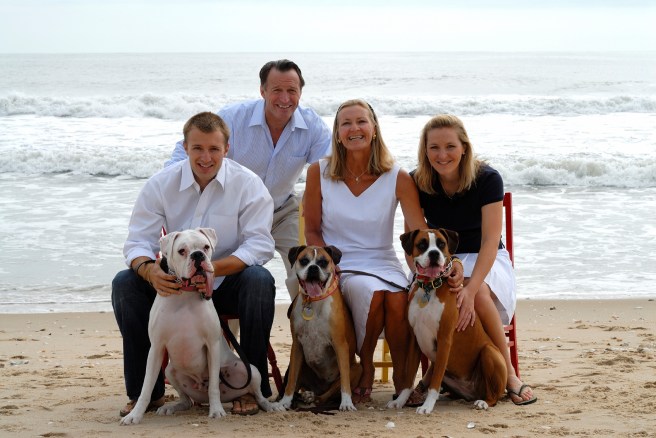
Every year since then, I’ve tried to be interesting and mildly amusing. I’ve failed. So this year, I went back to the well.Three Generation Family Standing Together Against Sea At Beach

Hi Everyone,

This has been a very good year for the Tisdales. The best we have had since the difficulty that abruptly shut down Adam’s company. Always one to see opportunities where others see obstacles, he used his time away to make contacts and refine his entrepreneurial plans.

What’s more, many of the people Adam met while he was on his federally enforced vacation contacted him with exciting business propositions and he’s helped them leverage their ideas into several powerful enterprises. After getting them established, Adam provided insurance so their dreams came true, undisturbed.

Suzanne is re-establishing herself as a fundraiser, with or without a cause, and we all hope she is successful beyond our wildest dreams. We took great delight last summer when the governor appointed her to the state ethics commission. She’s become quite upstanding.

Amber, our oldest, and her husband Nathan are raising our grandchildren and assuring that the legacy we are building will be secure. Her no-nonsense approach has proven to be a great asset in the Family business.

And then Chip. We hear that he’s been named a deputy district attorney back east. Apparently sometimes the apple does fall far from the tree.

Now we’re looking forward to those golden years we have promised ourselves. We’ll be here in San Diego if you have a chance to drop by. Just please call first. Unexpected visitors at the gate make us a little nervous, as you might imagine.

Happy 2016

Adam, Suzanne, Amber, Nathan, Amelia and Mason

Some people thought it was funny, so that was good. Other people couldn’t figure it out at all, and I thought that was funny, so that was good too. Some people looked at it and thought, oh, this again. And that was not good. This year’s card was not as good. I know it. You know it.

Next year I may have to fall back to boring old reality. Because Christmas cards are hard. Sequels are really hard.

Polite Talk

I have a problem with euphemisms.

Settle down. This is not a rail against political correctness. They should be called postal carriers and police officers. That’s just fine.

My problem is with sanitizing and gentrifying the language.

People die. It might be hard to take, but people don’t pass away. They die. We die. It’s supposed to be hard to take.

I cringe when I hear people say September 11th. Remember September 11th. No, remember that the United States was attacked. September 11th sounds like a date that is about to become a 40 percent off sale at Macy’s. President’s Day, Valentine’s Day, September 11th. How long before someone wishes you “Happy September 11.” Call it what it is. The country was attacked.

And now, this week, everywhere you turn, you hear another one. We are “putting boots on the ground” to fight ISIS, ISIL, Islamic State. Every military correspondent/advisor/pundit is talking about putting boots on the ground. Sounds like something John Wayne would do. “We’re putting boots on the ground, pardner.”

That glosses over the fact there are feet in those boots. 18, 20, 22 year old feet. 50 people, not boots. No one is reporting there are 100 boots being sent to Syria.

Now, I have no problem with putting boots on the ground. Litter that whole damn country with boots, if that will help. Fine. I have a big problem with going to war. And that’s what we’re doing. Sending kids to war. Again.

And that’s wrong. Again.

Remember those kids the next time you hear someone say we’re putting boots on the ground.

Facebook and Friends

Facebook has done something to annoy me again. And no, I don’t mean the threats to change the privacy settings or the plan to charge users for every mouse click. I’m fine with all that.

The thing I find annoying is the list of people in the middle of the page who Facebook has decided I might want to add as friends. Facebook is not supposed be a place to find new friends; it’s supposed to be a place to connect with the friends you’ve already got so you don’t have to actually talk to them.

Friend, in the Facebook world, being an illusory term at best.

The friend Facebook wants to introduce me to are friends of friends or friends of friends friends, and in almost every instance, no one I’ve ever heard of. Sort of friends once removed. So I ignore the suggestion. It’s hard enough to keep track of cousins once removed, or even to understand what they have been removed from, without having to categorize other people.

(Grammatical side-rant: “Once removed” is redundant. A cousin, or
anything other than a cat, cannot be twice removed. She’s either removed or she’s not).

Every year or so, when I was feeling even more curmudgeonly than usual, I would look through the list of Facebook friends I have accumulated, and cull the herd. It’s not something I had to do. If people consistently post idiotic claptrap (like this post for instance), I boot them right away. So what is left are the people who aren’t overtly offensive. But I sorted through it anyway. Just, because.

First to go were the people from work who, for some god-forsaken reason, I felt compelled to friend. Most of what they post are things they are compelled to post, by work. They’re gone from my list because, with a retirement date in sight, I have less and less reason to be appropriate.

If you know me—that is to say if you’re on my friends list—you know that I’ve never had any patience for doing the appropriate thing. So just imagine what I’m like now.

(Grammatical side-rant two: Facebook has made friend a verb. Another loss for the language. You no longer have to “make a friend.” You just “friend.” “I friended her.” And to think I was sure we had hit bottom when “effort” and “task” were made into  verbs. “We’re efforting that right now.” “He’s been tasked with efforting that.”)

Next to go are the people who post pictures without explaining what they are pictures of or who is in the picture or why they are significant, interesting or out of focus. I don’t know who those people in the picture are, whose wedding they are attending, where they are vacationing or what that symbol is on your front yard. After all, who do you think you are, a friend?

You would think I would expunge the people who rarely post anything, because, they’re just added baggage. But I am one of those people and I can’t be too hard on us.

So who does that leave? Well, there are the people who actually post interesting things. They’re keepers. I also keep the people who mostly post pictures of their kids and grandkids because, even though I don’t know the kids, you can’t delete kids or dogs. It’s just wrong. Cats, on the other hand…

Curiously, I keep the people who only post memes they have clipped from somewhere else. You know the ones; they look like they were made by American Greetings. A pencil sketch and a piece of short wisdom in Helvetica. It’s always the kind of thing George Carlin used to say, even though it turns out George Carlin never said most of the things he used to say. The stuff that makes you wish you had thought of that. Once in a while I read one that I had thought of, but I’m not good enough at graphics to make it into a post.

I do find these cut and paste memes annoying. I’d rather read what people have to say for themselves. But I’m willing to put up with them because I have no interest in going to whatever those sites are to find that stuff for myself.

I keep some friends just to bulk up the list. One of the few things I post, other than sarcastic and annoying comments about other peoples’ posts, is a link to these infrequent blog posts. I’m still childish enough—or perhaps I am once again childish enough—to watch anxiously to see how many people read my blografitti. Through diligent study of search engine optimization and marketing this blog now has a loyal and deeply disturbed readership in the mid-10s. For that I have my Facebook friends to thank.

And that gets me down to the last list. My actual friends. It’s a very short list. And getting shorter. But I keep them. I’m funny that way.

Why I Write

Photography is on the long list of things I want to be able to do but for which I have no talent, along with drawing, woodworking and pairs figure skating. And the common thread in all of that is my inability to turn those things I imagine into reality. That, and weak ankles.

I understand photography principles. I took those classes in journalism school and I took good notes. I can talk all about ASA and shutter speeds, and the differences between Kodacolor, Kodachrome and Ektachrome.

OK, so it’s been awhile.

But I can also expound upon the rule of threes; about using natural lines and shapes to draw your eye to a focal point; the importance of getting close to your subject, all that stuff.

But here’s the thing: I can look at something and imagine what the picture ought to look like. I just can’t take that picture. Not in the viewfinder and certainly not on the desktop. No amount of Photoshop can save it. I can’t translate what I think into what I see.

I guess that’s why I write. Reality doesn’t have to get in the way. Whatever I can think I can write. No harsh shadows, no blurs. I don’t have to worry about hitting the shutter just a fraction too soon or too late.

Case in point. I was at the 1982 U.S. Open Golf championship at Pebble Beach. I had conned my way into not only press credentials but a photo badge. I was inside the ropes with my Beseler Topcon. Perhaps you remember, this was the Open that Tom Watson won, beating Jack Nicklaus by chipping in for birdie from impossibly heavy rough at the back of the 17th green. Everyone else crouched in front of the green got a picture of the ball in the air headed for the hole. I got Watson pointing back at his caddie Bruce Williams, saying “I told you so.” Not much of a picture. I missed the moment.

Maybe it’s not me. Maybe it’s the camera. But no, a better camera just made my bad pictures more expensive.

On the other hand, I can write the same sentence with a pencil as I can with a Macbook Pro and no one knows the difference. Not that there’s a single thought in these nine paragraphs that anyone would hang on the wall (though the pairs figure skating line was sort of a nice touch).

I’ll admit though, that as a writer I am weak at descriptions and much better at dialogue. I wrote television news for far too long, where descriptions aren’t necessary. You have a photographer for that. I’m told that pictures are worth… a couple of hours of overtime.

In television news, the closest you get to describing anything are the words this and that. As in “the driver of this car drove into that house.” Doesn’t look like much here, but on TV, you’d get it. First rule of television news “say cow, see cow.” Don’t have a picture of a cow, don’t talk about it.

That’s why I want to be able to take pictures. To see cows. Cows that, by their very existence, describe the human condition. Gaunt and standing in a field bare of grass, far from the nearest water, with blank bovine stares silently chewing their cud. Never mind that there is precious little to chew. It is their nature. Standing motionless for hours, only their lower jaw moving.

Oh fuck, never mind, I hate cows. Dumbest animals on earth. Except, you know. Horses.

An Infinite Number of Monkeys

I opened Facebook to find that a friend had posted on my timeline. And to think that just a few years ago I didn’t even have a timeline. This was a link to an NPR story and a suggestion, actually more like a directive. “This story has your name all over it. I’ll be waiting for your blog!” she said.

I could have ignored that. I’m sitting here now thinking I should have ignored that. But my ego kicked in and I started wondering what it was about this article that made her think it would interest me. I mean, she is right. I am interested, somewhat appalled and feeling rather smug all at once. But that’s my problem. Why should I write about it?

So here’s the deal. The story is about a computer program that writes news stories. Hundreds of thousands of them, for places like Yahoo and the Associated Press. Because the AP is using them, there’s no doubt you are reading them – if you read news. It writes pretty basic stuff; there is after all a difference between news writing and news reporting. The computer isn’t gathering any facts. It gets that stuff from somewhere – maybe even someone – else, ingests it, digests it and defecates it out onto the screen.

NPR got this idea to put the computer to a test by pitting it against an actual reporter. They chose their White House correspondent Scott Horsley. And they chose a business story, the quarterly earnings of Denny’s. Scott might have had a leg up. Back when I used to bump into him at the NPR station in San Diego he was a business reporter and he is comfortable enough in his own skin to admit he was once a regular at Denny’s.

The competition had two parts. One was to judge the end product and the other was to get to that end first.

We all know where this is headed. The computer has already won at chess, Jeopardy and trying my patience. So it’s no surprise it was done with Denny’s in two minutes while Scott was savoring his greasy spoon prose for seven minutes. But part two, what did they write?

Here’s what the computer program shit out:

Denny’s Corporation on Monday reported first-quarter profit of 8.5 million dollars. The Spartanburg, South Carolina-based company said it had profit of 10 cents per share. The results beat Wall Street expectations. The average estimate of four analysts surveyed by Zacks Investment Research was for earnings of 9 cents per share. The restaurant operator posted revenue of $120.2 million in the period, also beating Street forecasts. Three analysts surveyed by Zacks expected $117.1 million. Denny’s shares have risen nearly 6 percent since the beginning of the year. In the final minutes of trading on Monday, shares hit $10.90, a climb of 61 percent in the last 12 months.

And here’s Scott’s:

Denny’s Corporation notched a grand slam of its own in the first quarter, earning a better-than-expected ten cents a share, as restaurant sales jumped by more than 7-percent. Operating revenues topped $120 million. Adjusted net income jumped 36 percent to $8.7 million. Denny’s is one of the nation’s largest full-service restaurant chains. The growth in sales suggests consumers are opening their pocketbooks for pancakes, eggs, and hash browns. Earnings were also helped by lower costs for raw materials. Denny’s results were also helped by the re-opening of the high-volume location inside the Las Vegas Casino Royale restaurant. After sales grew faster than expected in the first three months of the year, managers raised their sales forecast for the remainder of 2015.

The computer program may have come out ahead in search engine optimization, but Horsley comes out ahead in everything else.

The truth is, however, if these are supposed to be broadcast stories, they both suck. Honestly Scott, you get props for “grand slam” and did manage to mention Las Vegas, but what took you so damned long?

The cardinal rule of broadcast news is don’t bore the audience. If people aren’t still paying attention by the time you get to the end of the story, or if they forget what you said as soon as you’re done saying it, you’ve failed.

Scott lost me at “adjusted net income.” But in his defense, the story is a loser to begin with. Earnings at Denny’s for godsake. Nobody cares. Nobody. I doubt Denny even cares. The only reason anyone ever goes to Denny’s is because it’s still open after the bars close and you want something in your stomach when you throw up on your way home. So maybe you care if they announce they’re raising prices of their inedible menu, but that’s as far as it goes.

This whole computerized writing is another sign of the deterioration of news. Years ago the television station where I worked wanted news writers to both write the news and edit the video. I argued against it because, first, they are distinctly different skill sets and second, it takes longer to write and edit a story than it does to just write or just edit one. Yet the writers will still have the same number of stories to write and the deadline doesn’t change. When I said it would hurt the quality of the product the general manager actually snorted and I looked over to see him shaking his head.

Quality is such a quaint idea.

Not that we shouldn’t keep trying. I remember lamenting the consolidation of ownership in the media and was complaining to a friend who had worked at a couple television stations, a few newspapers, a magazine and at least one university that someday we would all be working for the phone company. “Yeah,” he said, “but those fuckers will need editors too.”

Apparently not.

Junk Mail

Here are some odd things I’ve noticed.

Representative Steve Scalise from Louisiana is the Majority Whip of the House of Representatives. He’s been getting a lot of criticism lately because he gave a speech to a white supremacist group in 2002. Scalise says he doesn’t remember it at all, but he’s sure he didn’t know who the group was or what they stood for when he gave the speech he doesn’t remember to the group he doesn’t remember.

In his defense he announced “I detest any kind of hate group. For anyone to suggest that I was involved with a group like that is insulting and ludicrous.”

He “detests any kind of hate group.” So by his own words, Scalise is a guy who hates people who hate people. Maybe suggesting that he’s involved with a group that hates people is not so ludicrous after all, since he’s proud to say he’s among them.

Pogo was right.

-0-

If a stray dog is caught in Europe, is it taken to the Dog Kilogram?

-0-

Among the junk that arrived in the mail this week was a flyer trying to get us to subscribe to a consumer newsletter. It promised valuable articles like “9 Secrets Hotels Don’t Want You to Know.” Secret number 8 was “It’s no secret that crime is increasing in hotels.”

Note to editor: If you’re going to publish an article called “9 Secrets Hotels Don’t Want You to Know,” don’t headline one of your secrets “It’s no secret…”

Another secret told how to get discounted rates at hotels. The advice was to call after 6 p.m. when they dump all the no–show reservations that were not secured by a credit card. OK, good tip. But then it went on to say “..in some cities, like New York and San Francisco, that time is 4:00.”

Note to editor: “..like New York and San Francisco”? Are you trying to explain what a city is by giving examples of two of them? Dubuque: not a city; San Francisco: city.

Or are you saying that in cities that are similar to New York and San Francisco the best time to call is at four o’clock? And if that’s the case, exactly what cities are like New York and San Francisco?

“Hello, is the Boston downtown Marriott? Are you like San Francisco?” “OK, OK, wrong number.”

Oh, and by the way, this list is online on at least seventeen different places and has been since 2008. So the odds of my buying your newsletter to have the same crap sent to my door – not real good.