Coincidence?

Time was, if I told someone I grew up in Minnesota I would get one of two reactions; either, “Oh, Min-n-ne-s-o-h-t-ah” in what they thought was a Scandinavian accent or, “B-r-r-r, it’s cold there.”

I had answers for those; “ya-a-ah” a three syllable word in what truly is a Scandinavian accent or, “nine months of winter and three months of bad sledding.”

Times were simpler then. Now, if I mention Minnesota, people invariably say “Ooh, Michele Bachmann.”

Rather than roll my eyes and shrug, I have decided I need a snappy comeback.  Something that will explain that a geographic quirk of fate is the only thing she and I could possibly have in common.

After all, I have one “l” and two “e’s” in my first name and two “n’s” in my last name.  She, on the other hand has….ONE “L” AND TWO “E’S ” IN HER FIRST NAME AND, OH MY GOD, TWO “N’S” IN HER LAST NAME.  But I have ten letters in my name; she has fifteen letters in her name.  I’m five years older than she is.

Five, ten and fifteen are all divisible by five. Coincidence, or conspiracy?  We could be twins.

But really, that’s all there is to it. I swear.

When she announced she was running for President, she confused John Wayne and John Wayne Gacy.  I would never make that mistake.  Serial killer Gacy lived in a city where I worked for a time – Waterloo, Iowa – where Bachmann was born.  That can’t mean anything.  It’s just a quirk, a fluke, an accident, a mistake, a total embarrassment to me.

Is it too late to claim I was born in Kenya?

-0-

Funny little side story about Waterloo Iowa.  After Gacy was tried and convicted of murdering 33 teenage boys, someone sent a pen to the television station newsroom where I was working.  It was one of those cheap promotional pens, probably very similar to the pen that’s nearest to you right now.  And it was imprinted “John Gacy for President – Waterloo Jaycees.”

I guess when he (and Bachmann) lived in Waterloo in the sixties he was active in the Jaycees and was named “outstanding vice president.”  So he decided to run for president and had those pens made up.  For a day, I had that pen in my desk drawer.  The next morning it was gone.  I’ve regretted it ever since.

So you want to talk about coincidences?  Michelle Bachmann of Waterloo Iowa mentioned John Wayne as being from her hometown when it was actually John Wayne Gacy who is from Waterloo Iowa, and both Bachmann and Gacy ran for president.  And the happiest coincidence:  neither of them wins.

Headlines

An Associated Press a headline today said Executives Don’t See Reason to Panic, Yet.  It was the first I realized panic is a reasoned response, arrived at only after long and considered study.

“Elizabeth, arrange a conference call with the board.  I’ve been looking over these balance sheets for two days now and I think it’s time to take a vote on panicking.”

“A videoconference, sir?”

“No, just on the phone.  I don’t want to tip my hand by letting the board see that my hair is on fire.”

Wile E. Coyote

Acme Industries’ Board Votes 7-6 Against Panic

Director Wile E. Coyote Casts Deciding Vote

“I’ve seen worse,” Coyote explained.  “Once you’ve run off the edge of a cliff with an anvil and a case of dynamite strapped to your leg, a few drops in stock prices don’t scare you much.”

Walking

We walk.  Every day without fail.  Some days not as far as other days, but always somewhere; even if it’s just around the block in the rain.  We’re not going anywhere.  This is not one of those “walk across America to cure people from ever wanting to walk again” stories.  There’s nothing heroic in where we go.  It’s just what we do.

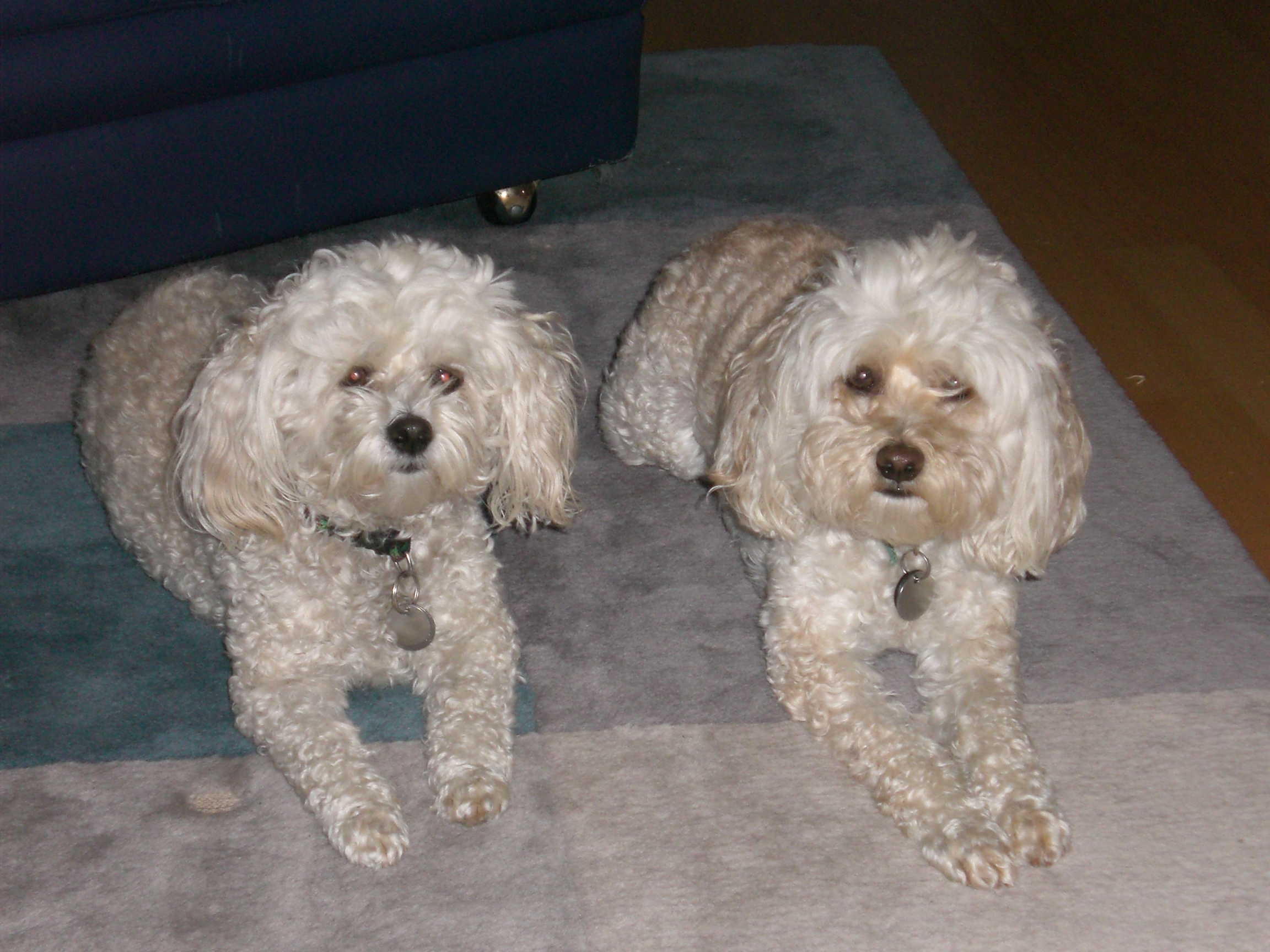
The dogs
Ginger and Rudy

It was probably my idea. They don’t have many ideas of their own, at least not many good ones.  But they took to it right away and now, even if I’m not feeling up to it, they bound out of bed and insist we go. There’s no point in trying to reason with them.

When we pass people on the sidewalk someone is almost certain to say “how cute.”  I figure they’re talking about the dogs, but I often ask.

I’ve had a dog most of my life—except for that part in the middle when I was living in apartments and moving from city to city.  But no question, we are dog people.  When my parents got married they got a Pekinese named Peke and not long after a Scottish terrier named Scottie.  Let’s just say the creativity gene pool was not overflowing.  I should be grateful they didn’t name me “Kid.”

It’s a funny thing, what a stabilizing force a habit can be.  We walked when my Mother died and after my brother called to say he was diagnosed with brain cancer and had less than a year to live.  And when he died, we walked.  We walked through my layoff and job search.  We walked through my leukemia diagnosis and we walked through chemotherapy.  Cheryl’s father died and we walked.  Cheryl prefers the treadmill because it doesn’t stop to sniff the bushes and you don’t have to pick up after it.

We walk down the street and wind through the blocks.  The route is a little different every day, but it’s all the same neighborhood.  We’ve seen the streets day in and day out for nearly eight years.   We know where the sidewalk is raised from overgrown tree roots.  We know who waters their lawn and when they water it.  We notice the landscaping.  (When did flower beds become “landscaping?”)

This morning I saw a house I hadn’t seen before.  We walk past it every day, sometimes both coming and going, but I’d never seen it.  I can tell you what plants they have in their yard and can describe the stucco wall around their planter, but I hadn’t noticed the house.  A whole house unseen.

That’s when I decided I have so much more to see.

Painting

It is fortunate my career path did not cross with a house painter.  I’m not a good painter.  It’s not that I dislike painting; I tolerate painting.

Because I am not a good house painter I need to be an exceptional house taper.  Blue tape is my friend.  I know there are those who say it is easier to go ahead and paint and then scrape the windows afterward.  And they may be right.  But when I’m done painting I want to be done with painting.  So I tape.

Today’s project was the frame of the back door.  Painting took about twenty minutes.  Taping took three and a half hours.  I laid out drop cloths and taped most of the house, all of the patio and half the yard.  This is just the way I paint, a method gained from painful experience.

There’s a certain knack to taping, if I say so myself, particularly when painting a door frame against a stucco wall.  The important thing is to establish a good seal to keep the paint from seeping under the tape.  If the tape isn’t tight you may as well not have taped at all.

So with all the self-assurance of a bicyclist with training wheels, I opened the paint can confident that I could get paint on the door frame, all the door frame and only the door frame.

I succeeded.  A primer coat and a finish coat.

Then I made the mistake.  The same mistake I’ve made before.  I’m anxious to see the results.  With paint-splotched blue tape all over the place I can’t really see what a good job of painting (or taping) I have done.  And I want to see the perfectly straight line at the edge of the door frame.  Want so desperately to see it that I start to strip the tape off before the paint is dry.  The paint on the tape is, I think, the last to dry.  In moments, the paint is on the hands I took such care to keep clean.  And the tape is balled up into one giant sticky mass of wet paint that leaves its indelible mark on everything within half an acre.  It’s as though the tape, having done its job to perfection, realizes it is about to be cast aside, receiving no credit.  And it strikes back.

If only I had been able to wait I wouldn’t have to spend an hour scrubbing my fingers, my hands and my arms up to my elbows.  Worse, I wouldn’t be taping the door frame next weekend while I paint the spots on the stucco where the tape, having become a paintball in every sense of the word, attacked the wall like an adhesive graffiti tagger.  Why did I bother taping?  I knew somewhere deep in my subconscious that I would make the mistake again.

I want to blame the tape, but I do blame the paint.  If only it weren’t so boring to watch paint dry, none of this would have happened.

Save The Date

Stricken by drought and unprecedented high temperatures brought on by the global warming hoax, the future of the humble but beloved date is in doubt.  Already a brown color that is distasteful in anyone’s description of a fruit and rather badly shriveled, it is hardly what one would choose to eat unless stranded in the desert.  Now, even there the date is smaller, harder and rarer.

Native to the deserts of Northern Africa, the date palm grows in oases fed since biblical times by underground springs.  Now the springs are sprung and the date palm is falling on hard times.  This can only mean bad things for the date and those who make their living selling it at exorbitant prices to starving nomads—not to mention what it means to the nomads and lovers of date nut bread.

What’s more, the winds have changed and are no longer favorable for the date palm.  As anyone who has studied the date knows, male and female flowers are produced on separate date palm trees, forcing the trees to pollinate in public to bear fruit. This was once accomplished by the wind, but without what can only be described as palm tree artificial insemination, it now takes multiple “date dates” to produce a date.  Those who care deeply about the date help swab the receptive stigma of the female with the potent pollen of the male.  While this would seem to be embarrassing for the date palm, we have been assured the trees enjoy the process, and many people who travel great distances to participate in the ritual find it extremely self-gratifying as well.

Today we’re happy to report there is hope as an ever growing number of people are becoming aware of the necessity to save the date.

Plan now to be in the Coachella Valley on August first as people from around the globe gather to draw attention to this cause and save the date.  Join hands with date lovers from every continent at the Date Shake Shop in Indio and form what can only be called an International Date Line.

Save the Date – Save the Date – Save the Date – Save the Date – Save the Date

A Cause You Can Sink Your Teeth In

Eleven

Optimism does not come easily to me. Maybe it’s my Scandinavian roots. Maybe it’s growing up in the gray and frozen North. Or maybe it’s thirty years of the cynicism and sarcasm of news. More probably, it is just because it is. I think people are hard wired to be the way they are. Some are happy and forward-looking. Some are self-confident and self-assured. Some are ambitious. Some are sure of what they want. Some are not.

Maybe that’s why I listen carefully, not only to what my doctor says, but how he says it. When he tells me the results of my tests are really good news, my first reaction is to wonder what he’s not telling me. Even so, I tend to hear what I want to hear at times like that. We walked away from my last appointment believing everything was looking up. The biopsy results couldn’t find any CLL cells. Only later did his words turn over and over in my head. I strained to remember and wondered if I asked the right questions, or if I would have gotten the full answer even if I had.

Because it’s not a curable disease, I’m sure it’s going to return. I think that when it does there will be advances in treatment that will push it back again, and maybe push it back forever. But I’m not expecting that. I’m expecting to have to deal with this for the rest of my life, and I’m not expecting the rest of my life to be long enough. That outlook comes partially from my lack of optimism and largely from being the only surviving member of my family. My mother lived to be nearly 90, and there’s longevity on her side of the family. I had an aunt on my dad’s side who lived well into her 80’s, and she had CLL. But, there’s not a long history of a long history among the Swansons.

I don’t go back to the clinic until January, and that’s just a follow up visit. But here’s a really peculiar thing: I miss it. All this year, my schedule has been filled with appointments, blood tests, chemotherapy, biopsies and clinic visits. It’s how I marked time, how I filled my calendar. Two weeks until my next chemo; blood test on Monday morning; CT scan in a month. It was also the way I knew how I felt. Watching my white blood cell and platelet counts go up and down told me if I was “normal” or not. For most of the year, I was not. Even after it was all over, my white count was low. And it will be January before I have another set of numbers to look at. I can assume the marrow has recovered from the beating the chemotherapy gave it and is doing what it is supposed to do. A normal person would do that. An optimistic, self-confident, forward-looking person.

If the numbers are good, I’ll be relieved, once again. If they are not, I’ll listen to how he explains that to be the case and I’ll take away from it what I want to hear. It will be something like “sometimes it takes several months.” It’s been several months, I’ll say. Then he’ll launch into a story about a patient somewhere who took even longer than this. I’ll be expected to take solace in that.
And I will, because I want everything to be all right. I’m just not so sure it will be. Because that’s the way I am.

Ten

I don’t know that dreams can come true. First of all, I can’t remember them. And secondly, they don’t make any sense. I wake up thinking “that was interesting” until I think about it. People who don’t know each other are together in places they’ve never been, walking down hallways that don’t lead to anywhere. And then I lose track of what it’s about.

So I’m not big on hoping dreams will come true.

But then we walked down the hallway into the exam room at the cancer center. The physician’s assistant who did my bone marrow biopsy came in and handed us a copy of the results. “Flow cytometry shows no evidence for a clonal B-lymphocyte population.” Interpretation — the leukemia is gone.

The report is two pages of incomprehensible medical jibberish that boil down to my bone marrow functioning properly and producing white cells, red cells and platelets the way it’s supposed to. Not enough of them yet, but it’s coming around.

It doesn’t make for great reading — there’s no plot and you can’t really even say there’s a beginning, a middle and an end. But I’ve read it word for word several times, and I’ll admit it brings a tear to my eye.

My doctor came in, said “you done good” and gave me a hug. All I had done was sit in a lounge chair with an IV needle in my hand, but I have new respect for the bulging veins on the back of my hand.

A lot of worry melted away when we left the clinic that day.

The next night, I took a cellphone picture of the label of a bottle of 30 year old Glenfiddich, added “test results are in” to the caption and sent it to my brother-in-law. He texted back “I’ll be right over.” We each had a glass and toasted my blood cells, literally and figuratively. That bottle had been tucked away for a couple of years, and while it tasted like the really good scotch that it is, the reason was better than the booze.

My next appointment is three months away. It’s a little odd not having a blood test or a clinic appointment or a chemotherapy treatment looming on the horizon. I won’t say I looked forward to them, but I marked time that way — two weeks until I go back in for chemo, blood test Tuesday and so on. The year’s gone by quickly. Fortunately, it’s gone in our favor.
Back there in the recesses of my head is the knowledge that it’s not considered a cure — though there are people who have had the same treatment I had and have no sign of CLL after nearly five years. So, it could be a cure.

And they’re working on a lot of things that hold the promise of being even better treatments, and a vaccine is in the works. Things that will be available some day — in case I’m not “cured” and need to fight it off again.

In the meantime, it’s everything we could have hoped for — like a dream come true.

Nine

It’s the question I hate most.

“How are you?”

Not the passing-in-the-hallway “Hi, how are you.” That one’s easy. “Fine, you?” is the answer, spoken without breaking stride.

But when someone who really wants to know looks me in the eye and sincerely asks “how are you?” I get a hollow feeling in my stomach. The honest answer is “I haven’t any idea.” I feel fine, but I have felt fine since long before I was diagnosed with leukemia. If they hadn’t told me I have a life-shortening disease I wouldn’t know about it yet.

Every time I see the doctor he asks how I’ve been feeling and I tell him I’m fine and have none of the list of symptoms he ticks through as he questions me. “I’m a pretty boring patient,” I tell him. “Boring is good, I like boring,” he tells me. It’s the conversation we have at every appointment. I’m planning to put it on tape.

My latest appointment was for a bone marrow biopsy. It’s a charming procedure where I lie on my stomach while they stick large needles into my hip. My doctor’s physician’s assistant performed the test. She came in and, along with asking my name and birthdate to be sure I am who they think I am, she asked if she had ever done a bone marrow biopsy on me before. That’s when I started to dislike her.

“Yes, twice before,” I informed her. I don’t think I ought to be the most important patient she sees, and I don’t think she ought to remember everything she’s ever done for every patient. But I do think she ought to take a couple minutes to look at the file and refresh her memory about me. It’s a big deal to me and I’d like to think I’m not just another bare butt to her.

That wasn’t the only reason I was unhappy to see the physician’s assistant. I had questions for my doctor, and he wasn’t there to ask. Plus, while she doesn’t recall, I remember vividly the last time she did my bone marrow biopsy. It almost killed her. She pushed and struggled and twisted and stopped and started three times before she was able to get the metal swizzle stick syringe into my hip. Then she drew out some of the core of the marrow and declared mission accomplished. She was dripping with sweat and happy to have it over with. I was the one with the sore hip.

When the results came in, she hadn’t secured enough core to get a decent sample to test. She shrugged, looked sheepish and said “I really tried.”

I would have thought she’d remember that. But when I told her the last biopsy had been aerobic for her, she gave no indication she recalled and said she hoped the stars were aligned better this time.

It did go more easily. She got the first, smaller needle in and drew out the liquid portion. As it is drawn out, I can feel it pulling all the way down my leg. It gives a whole new meaning to deep tissue massage. When it was time to get the core, she took two stabs at it — literally — and then announced she got it done.

Next week, I’ll see my doctor and get the results. That’s when we’ll find out if the physician’s assistant did it right. More than that, we’ll find out if there’s still CLL coursing through my veins, and I will have an answer to that question I hate.

Eight

(August 2008) The little plastic pill bottle sits on the desk—staring at me below the computer monitor—to remind me of two things: to take the anti-nausea pill at noon and then to go to the clinic at three for a Neulasta shot.

I stopped at the lab yesterday for a blood test and the results were less than stellar. As a result, they prescribed another shot to boost my flagging immune system. This shot has made me sick before, so I take the anti-nausea medication just in case. And, it’s a safe bet I’ll wake up stiff and sore. Neulasta makes me ache all over.

Not that I’m not inclined to be stiff and sore any way. I’ve never been a model of flexibility. I’ve tried stretching and taken yoga classes. Some people walk out of those classes feeling refreshed and invigorated. I limp out convinced that yoga is the Hindi word for torture.

People with CLL talk to each other in numbers. White blood cell counts, platelets, hemoglobin, red cells are all measured against the norm. I try to avoid such talk because it doesn’t really describe anything. It’s as though someone asks how you’re feeling and you answer “4.2.” But since I have no outward physical symptoms, the numbers are the only measure of how I’m doing. My white count, which is supposed to be building back up since I finished chemotherapy, has actually gone down further. The platelets are coming around slowly and my hemoglobin is still in the anemic range. Such is the fascinating world in which I live.

I’m not going to pretend it doesn’t bother me. I’ve pretended that before and it doesn’t last. I went through six months of chemotherapy and expected that I would be healthier than when I started. I still expect that when the tests are complete in September that I will be healthier. But these flagging blood test numbers worry me.
My doctor and his nurse tell me not to worry. It’s an exception to the “every case is different” assurance. I’m told they’ve seen a low white count in other patients in this clinical trial.

Still, doubts linger. In my case, the leukemia is traced to a single chromosome that went haywire. It’s supposedly responds well to treatment. And I’m hanging on to that hope.

On the other hand, the disease progressed rapidly in my case. That’s not good.

And then there was the chemotherapy itself. After three cycles, my white count was low enough that they cut the dosage of the fludarabine and cyclophosphamide. I continued to get the full dosage of Humax, the antibody. And by the sixth cycle, my platelet count was low enough that they cut out they fludarabine and cyclophosphamide altogether.

The CLL was virtually gone by the time I’d gone through three cycles and the doctor keeps saying he’s anticipating a complete response. But there is still a lot of room for uncertainty.

And if the bone marrow biopsy results come back October first and are not as good as I’m hoping, then what?

That’s the question I don’t even ask.

Seven

(August 2008) CLL is all about waiting. Since they don’t treat the disease until you either have symptoms or your blood lab results are bad, you’re in a period everyone refers to as “watch and wait.” Some people watch and wait for years. Not me. I started my chemotherapy one year after my diagnosis. Seemed long enough.

I made a conscious effort to be in good spirits when I went for chemotherapy. If I walked with a little spring in my step it would be clear that I was healthy and getting healthier. When they called my name, the assistant who escorted me to the infusion center would always say hello and ask how I was feeling. “I’m fine,” I’d say. “I can’t imagine why I’m even here.”

Chemotherapy infusion centers are not as dreary and dismal as you might envision them to be. There are some women with scarves on their heads and men with hollow eyes and skinny arms. But many of the patients don’t look any different than anyone else. And the conversation is pretty amazingly supportive.

Sitting in the waiting room, patients would greet each other as though they were long lost friends. Some weren’t feeling all that well, while many others felt fine, like me. But there was a common bond in what we were going through and, I think, a sort of resolve that we were going to come out on the other end of the treatments better than we went in.

Every nurse I had was great. In sixteen treatments, I only had the same nurse twice. There were times when they couldn’t find a vein and had to ask someone else to poke around for one, but that’s not a reflection on their ability. Some days, veins are just more stubborn than other days.

I’m not saying it’s the sort of place I’d like to go if I didn’t have to, but it’s not particularly hospital-like. There were volunteers walking around asking if you wanted more coffee or juice or if they could get anything for you. They had been through chemotherapy and other cancer treatments and were cured, and they came back to be with others. Wonderful people, those volunteers.

I didn’t find chemotherapy all that unpleasant. People would tell me they were sorry I had to go through it, or were happy for me once it was over. But to me, it was a four day work week, and two of those four were just half days. I read books, watched TV, kept up with my office e-mail, got waited on hand and foot (mostly hand, since that’s where they put the IV) and read a lot online. If only there had been a putting green.

So in the middle of June it all came to an end. For all I’ve said about how little it bothered me, I walked out of there pretty happy. My nurse told me to come back to visit and I said “thanks, but as nice as you’ve been to me, my plan is never to see you again in my life.”

My blood test results are coming around, but more slowly than I hoped. According to the treatment plan, I wasn’t supposed to have to come in for blood tests for three months. But with my white count still hovering near bubble boy, they wanted me to come back every couple weeks. My platelets had gone up and then dropped down again. No one seems to be particularly concerned about any of this, and they play down the significance of it, but if there’s really no problem, why am I going in for extra blood tests?

We won’t really know how well the chemotherapy worked until the first of October. I have another bone marrow biopsy in the middle of September and then get the results two weeks later. I’m not expecting good results. I’m expecting great results.

In April of 2007 I had a bone marrow biopsy that showed 79 percent—four out of five—of my white cells were leukemia cells. A year later, after three cycles of chemotherapy, the biopsy results came back with .04 percent—four out of ten thousand—of my white cells were leukemia cells. My doctor looked at that and said all we needed to do with cycles four, five and six was “mop up.” Less than one cell in ten thousand is considered a complete response, and in the closest he comes to a definitive statement my doctor said he is expecting a complete response.

In the meantime, I wait.